[InternVL] Scaling up Vision Foundation Models and Aligning for Generic Visual-Linguistic Tasks
1、主要贡献
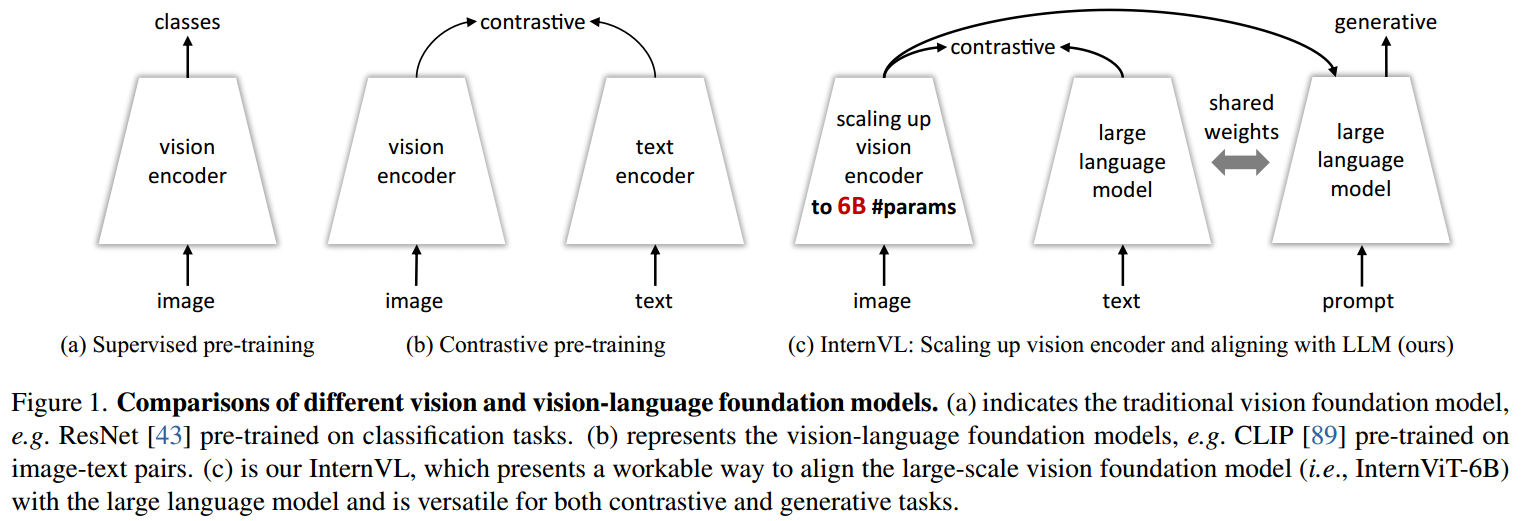
1)用TFS的方式对齐大规模的视觉编码器与LLM
2)noisy数据用于对比学习,高质量数据用于生成式学习
2、模型结构
1)视觉编码器:Intern ViT - 6B
-> 参数规模大大扩增
-> 在参数量相同的情况下,model depth、head dimension、MLP ratio对速度和准确率的影响不大
2)语言中介:QLLaMA - 8B
-> 在LLaMA-7B基础上新增96个可学习的queries和1B参数的cross-attention层
-> 即便LLM decoder固定,InternVL也可以在多模态对话任务上表现良好
3、训练
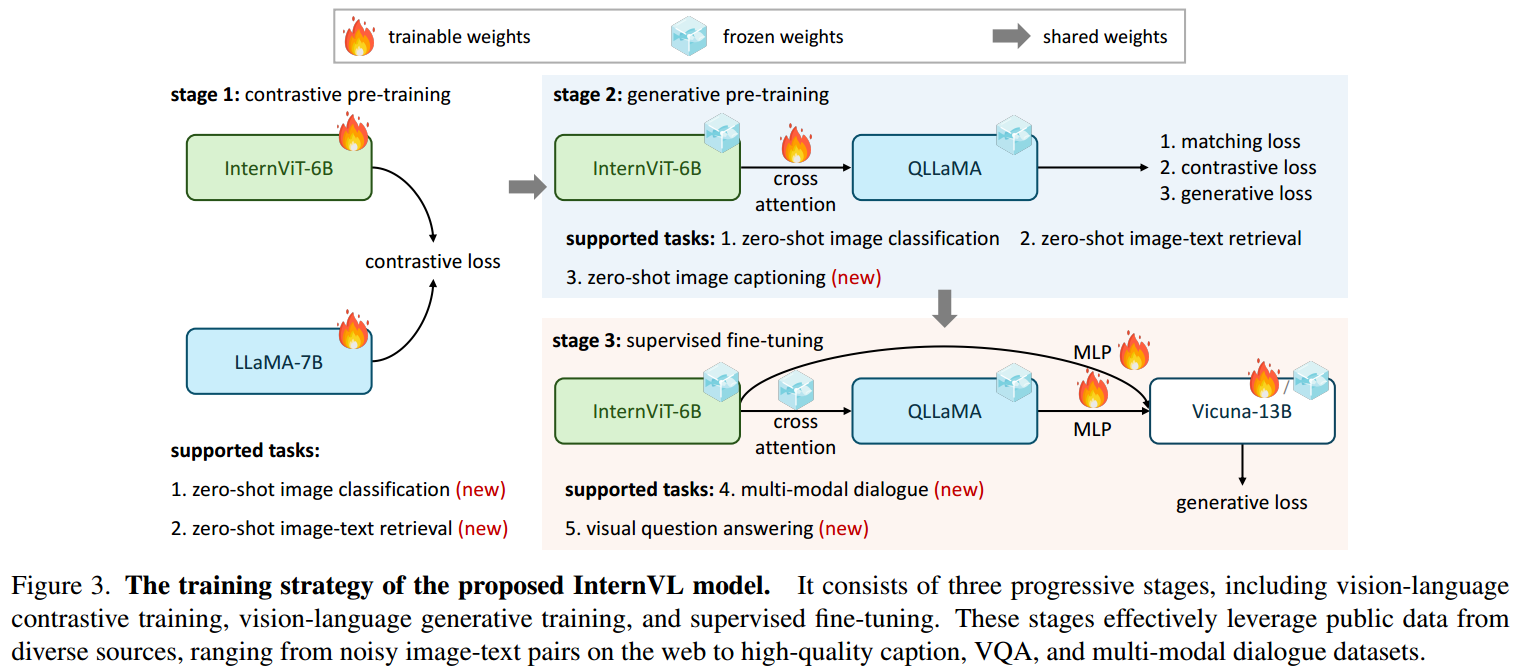
1)数据
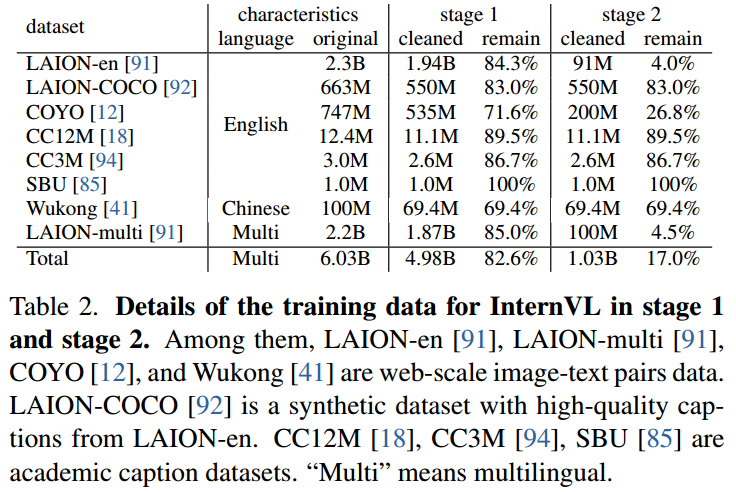
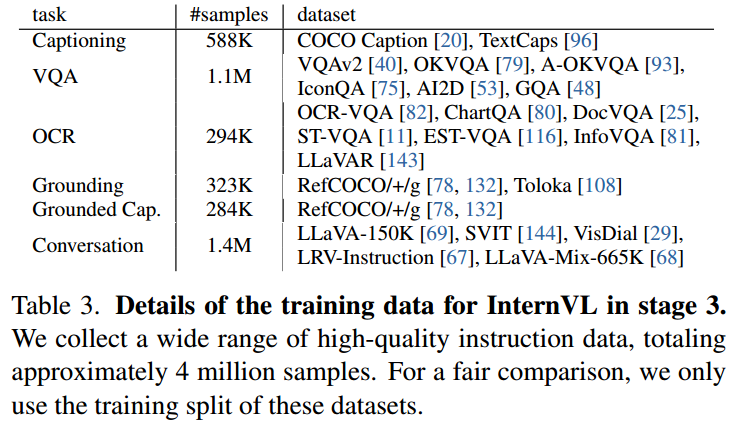
2)阶段
a)stage1:vision-language contrastive training
-> noisy image-text pairs on the web
-> LLaMA编码文本特征,InternViT编码图像特征
-> similarity score的symmetric cross-entropy loss
-> 同时更新LLaMA和InternViT的参数
b)stage2:vision-language generative training
-> high-quality caption, VQA
-> image-text contrastive (ITC) loss, image-text matching (ITM) loss, image-grounded text generation (ITG) loss
-> 固定LLaMA和InternViT的参数,只训练新增的learnable queries和cross-attention层的参数
c)stage3:supervised fine-tuning
-> multi-modal dialogue datasets
-> 用MLP层与LLM decoder相连
-> 仅训练MLP层(with QLLaMA)即可获得鲁棒的结果
4、应用
1)visual perception
image(H x W x 3) -> feature map(H/14 x W/14 x D)
2)contrastive tasks
InternViT(with QLLaMA)编码图像特征,QLLaMA编码文本特征
3)generative tasks
InternViT编码的图像特征作为QLLaMA的前置文本特征,用于文本生成
4)multi-modal dialogue
InternViT(with QLLaMA)编码图像特征,输入LLM

开源鸿蒙跨平台开发社区汇聚开发者与厂商,共建“一次开发,多端部署”的开源生态,致力于降低跨端开发门槛,推动万物智联创新。
更多推荐

 12
12 0
0- 0


 已为社区贡献1条内容

所有评论(0)