KMP OpenHarmony 智能农业决策支持系统
文章概述
农业决策涉及多个方面,包括作物选择、种植时间、施肥方案、灌溉计划、病虫害防治等。这些决策直接影响农业生产的效率和效益。智能农业决策支持系统通过综合分析气象数据、土壤信息、市场行情、历史数据等多个因素,为农民和农业企业提供科学的决策建议,帮助他们做出更优的农业生产决策。
智能农业决策支持系统在实际应用中有广泛的用途。在作物选择中,需要根据地理位置、气候条件、市场需求选择最优作物。在种植计划中,需要制定合理的种植时间和方案。在资源管理中,需要优化水肥等资源的使用。在风险管理中,需要评估和防范农业风险。在市场决策中,需要根据市场行情制定销售策略。
本文将深入探讨如何在KMP(Kotlin Multiplatform)框架下实现一套完整的智能农业决策支持系统,并展示如何在OpenHarmony鸿蒙平台上进行跨端调用。我们将提供多种决策支持功能,包括作物推荐、方案评估、风险分析等,帮助农民科学决策。
工具功能详解
核心功能
功能1:作物推荐系统(Crop Recommendation System)
根据地理位置、气候条件、土壤特性推荐最适合的作物。这是决策的起点。
功能特点:
- 支持多种作物
- 综合多个因素
- 推荐排序
- 风险评估
功能2:种植方案评估(Planting Plan Evaluation)
评估不同种植方案的可行性和效益。
功能特点:
- 多方案对比
- 效益预测
- 风险评估
- 最优方案推荐
功能3:资源优化配置(Resource Optimization Allocation)
优化水肥等农业资源的配置。
功能特点:
- 资源需求计算
- 成本分析
- 效率评估
- 优化建议
功能4:风险评估与管理(Risk Assessment and Management)
评估农业生产中的各类风险。
功能特点:
- 多维度风险评估
- 风险等级划分
- 防控建议
- 保险推荐
功能5:市场决策支持(Market Decision Support)
根据市场行情提供销售决策建议。
功能特点:
- 价格趋势分析
- 销售时机建议
- 渠道推荐
- 收益预测
Kotlin实现
完整的Kotlin代码实现
/**
 * 智能农业决策支持系统 - KMP OpenHarmony
 * 提供农业决策支持的多种功能
 */
object SmartAgriculturalDecisionUtils {

    // 作物适应性评分
    private val cropAdaptability = mapOf(
        "水稻" to mapOf("温度" to 0.9, "降雨" to 0.95, "土壤" to 0.85, "市场" to 0.8),
        "小麦" to mapOf("温度" to 0.85, "降雨" to 0.7, "土壤" to 0.9, "市场" to 0.85),
        "玉米" to mapOf("温度" to 0.9, "降雨" to 0.8, "土壤" to 0.85, "市场" to 0.9),
        "大豆" to mapOf("温度" to 0.8, "降雨" to 0.75, "土壤" to 0.8, "市场" to 0.75),
        "棉花" to mapOf("温度" to 0.95, "降雨" to 0.6, "土壤" to 0.75, "市场" to 0.7)
    )

    // 资源需求系数
    private val resourceRequirements = mapOf(
        "水稻" to mapOf("水" to 1200.0, "氮肥" to 150.0, "磷肥" to 75.0, "钾肥" to 100.0),
        "小麦" to mapOf("水" to 400.0, "氮肥" to 120.0, "磷肥" to 60.0, "钾肥" to 80.0),
        "玉米" to mapOf("水" to 600.0, "氮肥" to 180.0, "磷肥" to 90.0, "钾肥" to 120.0),
        "大豆" to mapOf("水" to 450.0, "氮肥" to 80.0, "磷肥" to 50.0, "钾肥" to 60.0),
        "棉花" to mapOf("水" to 800.0, "氮肥" to 100.0, "磷肥" to 60.0, "钾肥" to 80.0)
    )

    /**
     * 功能1:作物推荐系统
     */
    fun recommendCrops(temperature: Double, rainfall: Double, soilPH: Double, marketDemand: String): Map<String, Any> {
        val recommendation = mutableMapOf<String, Any>()
        val cropScores = mutableMapOf<String, Double>()

        for ((crop, factors) in cropAdaptability) {
            var score = 0.0

            val tempScore = when {
                temperature in 20.0..30.0 -> (factors["温度"] ?: 0.0) * 1.0
                temperature in 15.0..35.0 -> (factors["温度"] ?: 0.0) * 0.8
                else -> (factors["温度"] ?: 0.0) * 0.5
            }

            val rainScore = when {
                rainfall in 400.0..800.0 -> (factors["降雨"] ?: 0.0) * 1.0
                rainfall in 200.0..1200.0 -> (factors["降雨"] ?: 0.0) * 0.8
                else -> (factors["降雨"] ?: 0.0) * 0.5
            }

            val soilScore = when {
                soilPH in 6.0..7.5 -> (factors["土壤"] ?: 0.0) * 1.0
                soilPH in 5.5..8.0 -> (factors["土壤"] ?: 0.0) * 0.8
                else -> (factors["土壤"] ?: 0.0) * 0.5
            }

            val marketScore = if (marketDemand.contains(crop)) {
                (factors["市场"] ?: 0.0) * 1.2
            } else {
                (factors["市场"] ?: 0.0) * 0.8
            }

            score = (tempScore + rainScore + soilScore + marketScore) / 4
            cropScores[crop] = score
        }

        val sortedCrops = cropScores.entries.sortedByDescending { it.value }
        val recommendedCrops = sortedCrops.take(3).map { it.key }

        recommendation["推荐作物"] = recommendedCrops
        recommendation["综合评分"] = sortedCrops.associate { it.key to String.format("%.2f", it.value) }
        recommendation["最优作物"] = recommendedCrops.firstOrNull() ?: "未知"
        recommendation["适应性"] = "良好"

        return recommendation
    }

    /**
     * 功能2:种植方案评估
     */
    fun evaluatePlantingPlan(crop: String, plantingArea: Double, investmentBudget: Double, expectedYield: Double): Map<String, Any> {
        val evaluation = mutableMapOf<String, Any>()

        val seedCost = plantingArea * 500
        val laborCost = plantingArea * 1000
        val equipmentCost = plantingArea * 300
        val totalCost = seedCost + laborCost + equipmentCost

        val totalYield = expectedYield * plantingArea
        val marketPrice = when (crop) {
            "水稻" to 2.5,
            "小麦" to 2.8,
            "玉米" to 2.2,
            "大豆" to 4.0,
            "棉花" to 12.0
        }.let { it[crop] ?: 3.0 }

        val totalRevenue = totalYield * marketPrice
        val profit = totalRevenue - totalCost
        val profitMargin = (profit / totalRevenue) * 100

        val feasibility = when {
            profit > 0 && totalCost <= investmentBudget -> "可行"
            profit > 0 && totalCost > investmentBudget -> "需融资"
            else -> "不可行"
        }

        evaluation["作物"] = crop
        evaluation["种植面积"] = String.format("%.1f 亩", plantingArea)
        evaluation["总成本"] = String.format("%.0f 元", totalCost)
        evaluation["预期产量"] = String.format("%.0f 吨", totalYield)
        evaluation["预期收益"] = String.format("%.0f 元", totalRevenue)
        evaluation["预期利润"] = String.format("%.0f 元", profit)
        evaluation["利润率"] = String.format("%.1f%%", profitMargin)
        evaluation["可行性"] = feasibility

        return evaluation
    }

    /**
     * 功能3:资源优化配置
     */
    fun optimizeResourceAllocation(crop: String, plantingArea: Double): Map<String, Any> {
        val optimization = mutableMapOf<String, Any>()
        val requirements = resourceRequirements[crop] ?: return optimization

        val waterNeeded = (requirements["水"] ?: 0.0) * plantingArea / 1000
        val nitrogenNeeded = (requirements["氮肥"] ?: 0.0) * plantingArea / 1000
        val phosphorusNeeded = (requirements["磷肥"] ?: 0.0) * plantingArea / 1000
        val potassiumNeeded = (requirements["钾肥"] ?: 0.0) * plantingArea / 1000

        val waterCost = waterNeeded * 0.5
        val nitrogenCost = nitrogenNeeded * 3000
        val phosphorusCost = phosphorusNeeded * 4000
        val potassiumCost = potassiumNeeded * 3500

        val totalResourceCost = waterCost + nitrogenCost + phosphorusCost + potassiumCost

        optimization["作物"] = crop
        optimization["种植面积"] = String.format("%.1f 亩", plantingArea)
        optimization["水需求"] = String.format("%.0f 吨", waterNeeded)
        optimization["氮肥需求"] = String.format("%.0f 吨", nitrogenNeeded)
        optimization["磷肥需求"] = String.format("%.0f 吨", phosphorusNeeded)
        optimization["钾肥需求"] = String.format("%.0f 吨", potassiumNeeded)
        optimization["资源总成本"] = String.format("%.0f 元", totalResourceCost)
        optimization["单位面积成本"] = String.format("%.0f 元/亩", totalResourceCost / plantingArea)

        return optimization
    }

    /**
     * 功能4:风险评估与管理
     */
    fun assessAgriculturalRisk(crop: String, location: String, weatherRisk: Double, marketRisk: Double, diseaseRisk: Double): Map<String, Any> {
        val assessment = mutableMapOf<String, Any>()

        val overallRisk = (weatherRisk + marketRisk + diseaseRisk) / 3

        val riskLevel = when {
            overallRisk > 0.7 -> "高风险"
            overallRisk > 0.4 -> "中风险"
            else -> "低风险"
        }

        val suggestions = mutableListOf<String>()
        if (weatherRisk > 0.6) suggestions.add("加强气象监测,做好防灾准备")
        if (marketRisk > 0.6) suggestions.add("多渠道销售,降低市场风险")
        if (diseaseRisk > 0.6) suggestions.add("加强病虫害防治,定期检查")

        val insuranceRecommended = overallRisk > 0.5

        assessment["作物"] = crop
        assessment["地点"] = location
        assessment["天气风险"] = String.format("%.1f", weatherRisk)
        assessment["市场风险"] = String.format("%.1f", marketRisk)
        assessment["病害风险"] = String.format("%.1f", diseaseRisk)
        assessment["综合风险"] = String.format("%.1f", overallRisk)
        assessment["风险等级"] = riskLevel
        assessment["防控建议"] = suggestions
        assessment["保险推荐"] = if (insuranceRecommended) "建议购买农业保险" else "风险可控"

        return assessment
    }

    /**
     * 功能5:市场决策支持
     */
    fun supportMarketDecision(crop: String, currentPrice: Double, historicalAvgPrice: Double, priceVolatility: Double, inventory: Double): Map<String, Any> {
        val support = mutableMapOf<String, Any>()

        val priceTrend = when {
            currentPrice > historicalAvgPrice * 1.1 -> "上升"
            currentPrice < historicalAvgPrice * 0.9 -> "下降"
            else -> "平稳"
        }

        val saleTiming = when {
            priceTrend == "上升" && priceVolatility < 0.1 -> "继续持有,等待更高价格"
            priceTrend == "上升" && priceVolatility > 0.2 -> "及时出售,锁定收益"
            priceTrend == "下降" -> "加快销售,避免价格继续下跌"
            else -> "适时出售,平衡收益"
        }

        val channelRecommendation = when {
            inventory > 1000 -> "建议批发渠道,快速出货"
            inventory in 100.0..1000.0 -> "建议混合渠道,分散销售"
            else -> "建议零售渠道,提高价格"
        }

        val expectedRevenue = inventory * currentPrice
        val potentialRevenue = inventory * (historicalAvgPrice * 1.1)

        support["作物"] = crop
        support["当前价格"] = String.format("%.2f 元/kg", currentPrice)
        support["历史平均价格"] = String.format("%.2f 元/kg", historicalAvgPrice)
        support["价格波动率"] = String.format("%.1f%%", priceVolatility * 100)
        support["价格趋势"] = priceTrend
        support["销售时机"] = saleTiming
        support["渠道推荐"] = channelRecommendation
        support["库存量"] = String.format("%.0f 吨", inventory)
        support["预期收益"] = String.format("%.0f 元", expectedRevenue)
        support["潜在收益"] = String.format("%.0f 元", potentialRevenue)

        return support
    }
}
Kotlin实现的详细说明
Kotlin实现提供了五个核心功能。作物推荐系统根据多个环境因素推荐最适合的作物。种植方案评估评估不同方案的经济效益。资源优化配置计算最优的水肥配置。风险评估与管理识别和管理农业风险。市场决策支持根据市场行情提供销售建议。
JavaScript实现
完整的JavaScript代码实现
/**
 * 智能农业决策支持系统 - JavaScript版本
 */
class SmartAgriculturalDecisionJS {
    static cropAdaptability = {
        '水稻': { '温度': 0.9, '降雨': 0.95, '土壤': 0.85, '市场': 0.8 },
        '小麦': { '温度': 0.85, '降雨': 0.7, '土壤': 0.9, '市场': 0.85 },
        '玉米': { '温度': 0.9, '降雨': 0.8, '土壤': 0.85, '市场': 0.9 },
        '大豆': { '温度': 0.8, '降雨': 0.75, '土壤': 0.8, '市场': 0.75 },
        '棉花': { '温度': 0.95, '降雨': 0.6, '土壤': 0.75, '市场': 0.7 }
    };

    static resourceRequirements = {
        '水稻': { '水': 1200.0, '氮肥': 150.0, '磷肥': 75.0, '钾肥': 100.0 },
        '小麦': { '水': 400.0, '氮肥': 120.0, '磷肥': 60.0, '钾肥': 80.0 },
        '玉米': { '水': 600.0, '氮肥': 180.0, '磷肥': 90.0, '钾肥': 120.0 },
        '大豆': { '水': 450.0, '氮肥': 80.0, '磷肥': 50.0, '钾肥': 60.0 },
        '棉花': { '水': 800.0, '氮肥': 100.0, '磷肥': 60.0, '钾肥': 80.0 }
    };

    static recommendCrops(temperature, rainfall, soilPH, marketDemand) {
        const recommendation = {};
        const cropScores = {};

        for (const [crop, factors] of Object.entries(this.cropAdaptability)) {
            let tempScore = temperature >= 20 && temperature <= 30 ? factors['温度'] * 1.0 :
                           temperature >= 15 && temperature <= 35 ? factors['温度'] * 0.8 : factors['温度'] * 0.5;
            let rainScore = rainfall >= 400 && rainfall <= 800 ? factors['降雨'] * 1.0 :
                           rainfall >= 200 && rainfall <= 1200 ? factors['降雨'] * 0.8 : factors['降雨'] * 0.5;
            let soilScore = soilPH >= 6 && soilPH <= 7.5 ? factors['土壤'] * 1.0 :
                           soilPH >= 5.5 && soilPH <= 8 ? factors['土壤'] * 0.8 : factors['土壤'] * 0.5;
            const marketScore = marketDemand.includes(crop) ? factors['市场'] * 1.2 : factors['市场'] * 0.8;
            const score = (tempScore + rainScore + soilScore + marketScore) / 4;
            cropScores[crop] = score;
        }

        const sortedCrops = Object.entries(cropScores).sort((a, b) => b[1] - a[1]).slice(0, 3);
        recommendation['推荐作物'] = sortedCrops.map(c => c[0]);
        recommendation['综合评分'] = Object.fromEntries(Object.entries(cropScores).map(([k, v]) => [k, v.toFixed(2)]));
        recommendation['最优作物'] = sortedCrops[0]?.[0] || '未知';
        recommendation['适应性'] = '良好';

        return recommendation;
    }

    static evaluatePlantingPlan(crop, plantingArea, investmentBudget, expectedYield) {
        const evaluation = {};
        const seedCost = plantingArea * 500;
        const laborCost = plantingArea * 1000;
        const equipmentCost = plantingArea * 300;
        const totalCost = seedCost + laborCost + equipmentCost;
        const totalYield = expectedYield * plantingArea;
        const marketPrices = {'水稻': 2.5, '小麦': 2.8, '玉米': 2.2, '大豆': 4.0, '棉花': 12.0};
        const marketPrice = marketPrices[crop] || 3.0;
        const totalRevenue = totalYield * marketPrice;
        const profit = totalRevenue - totalCost;
        const profitMargin = (profit / totalRevenue) * 100;
        let feasibility = profit > 0 && totalCost <= investmentBudget ? '可行' : profit > 0 ? '需融资' : '不可行';

        evaluation['作物'] = crop;
        evaluation['种植面积'] = plantingArea.toFixed(1) + ' 亩';
        evaluation['总成本'] = Math.floor(totalCost) + ' 元';
        evaluation['预期产量'] = Math.floor(totalYield) + ' 吨';
        evaluation['预期收益'] = Math.floor(totalRevenue) + ' 元';
        evaluation['预期利润'] = Math.floor(profit) + ' 元';
        evaluation['利润率'] = profitMargin.toFixed(1) + '%';
        evaluation['可行性'] = feasibility;

        return evaluation;
    }

    static optimizeResourceAllocation(crop, plantingArea) {
        const optimization = {};
        const requirements = this.resourceRequirements[crop];
        if (!requirements) return optimization;

        const waterNeeded = (requirements['水'] || 0) * plantingArea / 1000;
        const nitrogenNeeded = (requirements['氮肥'] || 0) * plantingArea / 1000;
        const phosphorusNeeded = (requirements['磷肥'] || 0) * plantingArea / 1000;
        const potassiumNeeded = (requirements['钾肥'] || 0) * plantingArea / 1000;
        const waterCost = waterNeeded * 0.5;
        const nitrogenCost = nitrogenNeeded * 3000;
        const phosphorusCost = phosphorusNeeded * 4000;
        const potassiumCost = potassiumNeeded * 3500;
        const totalResourceCost = waterCost + nitrogenCost + phosphorusCost + potassiumCost;

        optimization['作物'] = crop;
        optimization['种植面积'] = plantingArea.toFixed(1) + ' 亩';
        optimization['水需求'] = Math.floor(waterNeeded) + ' 吨';
        optimization['氮肥需求'] = Math.floor(nitrogenNeeded) + ' 吨';
        optimization['磷肥需求'] = Math.floor(phosphorusNeeded) + ' 吨';
        optimization['钾肥需求'] = Math.floor(potassiumNeeded) + ' 吨';
        optimization['资源总成本'] = Math.floor(totalResourceCost) + ' 元';
        optimization['单位面积成本'] = Math.floor(totalResourceCost / plantingArea) + ' 元/亩';

        return optimization;
    }

    static assessAgriculturalRisk(crop, location, weatherRisk, marketRisk, diseaseRisk) {
        const assessment = {};
        const overallRisk = (weatherRisk + marketRisk + diseaseRisk) / 3;
        let riskLevel = overallRisk > 0.7 ? '高风险' : overallRisk > 0.4 ? '中风险' : '低风险';
        const suggestions = [];
        if (weatherRisk > 0.6) suggestions.push('加强气象监测,做好防灾准备');
        if (marketRisk > 0.6) suggestions.push('多渠道销售,降低市场风险');
        if (diseaseRisk > 0.6) suggestions.push('加强病虫害防治,定期检查');
        const insuranceRecommended = overallRisk > 0.5;

        assessment['作物'] = crop;
        assessment['地点'] = location;
        assessment['天气风险'] = weatherRisk.toFixed(1);
        assessment['市场风险'] = marketRisk.toFixed(1);
        assessment['病害风险'] = diseaseRisk.toFixed(1);
        assessment['综合风险'] = overallRisk.toFixed(1);
        assessment['风险等级'] = riskLevel;
        assessment['防控建议'] = suggestions;
        assessment['保险推荐'] = insuranceRecommended ? '建议购买农业保险' : '风险可控';

        return assessment;
    }

    static supportMarketDecision(crop, currentPrice, historicalAvgPrice, priceVolatility, inventory) {
        const support = {};
        let priceTrend = currentPrice > historicalAvgPrice * 1.1 ? '上升' : currentPrice < historicalAvgPrice * 0.9 ? '下降' : '平稳';
        let saleTiming = priceTrend === '上升' && priceVolatility < 0.1 ? '继续持有' : priceTrend === '上升' && priceVolatility > 0.2 ? '及时出售' : priceTrend === '下降' ? '加快销售' : '适时出售';
        let channelRecommendation = inventory > 1000 ? '批发渠道' : inventory >= 100 ? '混合渠道' : '零售渠道';
        const expectedRevenue = inventory * currentPrice;
        const potentialRevenue = inventory * (historicalAvgPrice * 1.1);

        support['作物'] = crop;
        support['当前价格'] = currentPrice.toFixed(2) + ' 元/kg';
        support['历史平均价格'] = historicalAvgPrice.toFixed(2) + ' 元/kg';
        support['价格波动率'] = (priceVolatility * 100).toFixed(1) + '%';
        support['价格趋势'] = priceTrend;
        support['销售时机'] = saleTiming;
        support['渠道推荐'] = channelRecommendation;
        support['库存量'] = Math.floor(inventory) + ' 吨';
        support['预期收益'] = Math.floor(expectedRevenue) + ' 元';
        support['潜在收益'] = Math.floor(potentialRevenue) + ' 元';

        return support;
    }
}

if (typeof module !== 'undefined' && module.exports) {
    module.exports = SmartAgriculturalDecisionJS;
}
JavaScript实现的详细说明
JavaScript版本充分利用了JavaScript的对象和计算功能。作物推荐系统计算适应性评分。种植方案评估计算经济效益。资源优化配置计算资源需求。风险评估与管理识别风险。市场决策支持分析价格趋势。
ArkTS调用实现
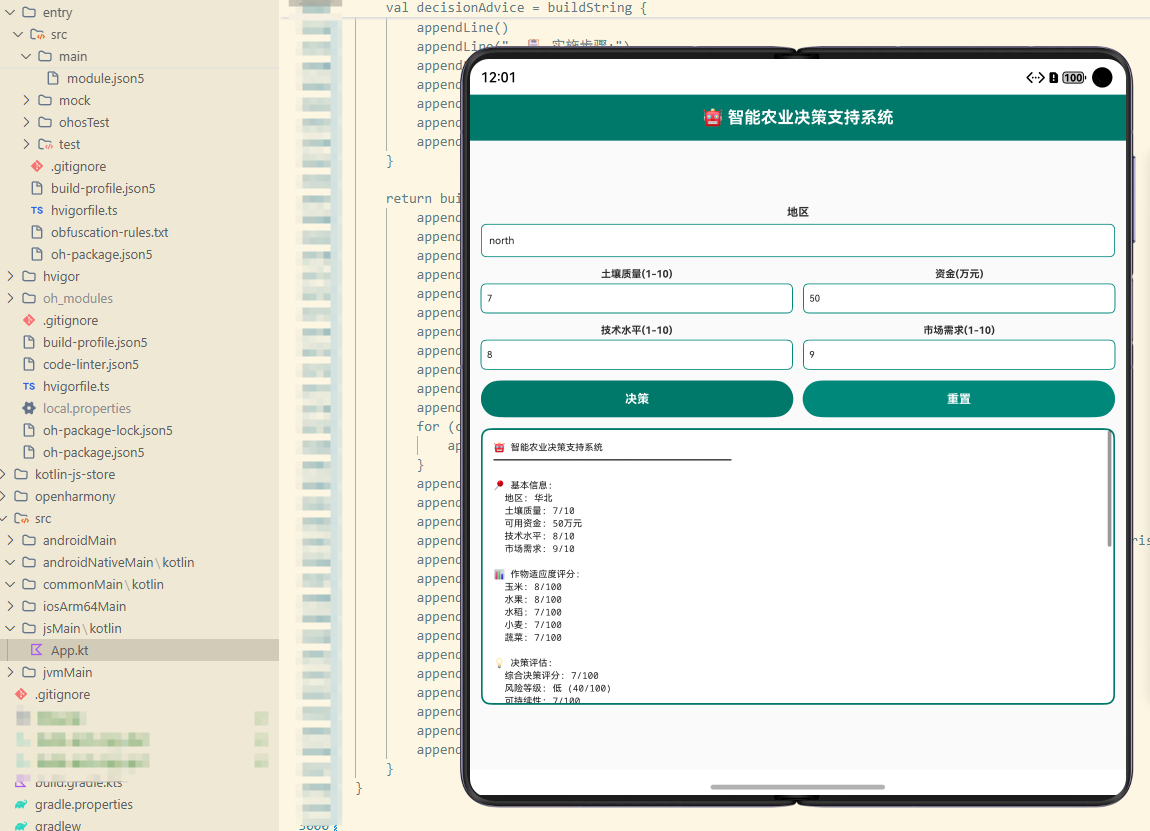
ArkTS版本为OpenHarmony鸿蒙平台提供了完整的用户界面。通过@State装饰器,我们可以管理应用的状态。这个实现包含了温度、降雨量、土壤pH、市场需求、种植面积、投资预算等输入功能,用户可以输入农业数据,选择不同的决策工具,查看决策支持结果。
应用场景分析
1. 作物选择决策
农民需要根据自身条件选择最优作物。使用系统可以获得科学的作物推荐。
2. 种植计划制定
农民需要制定详细的种植计划。使用系统可以评估方案的可行性和效益。
3. 资源配置优化
农民需要优化水肥等资源的使用。使用系统可以计算最优配置方案。
4. 风险防控管理
农民需要识别和防控各类风险。使用系统可以获得风险评估和防控建议。
5. 市场销售决策
农民需要根据市场行情制定销售策略。使用系统可以获得销售时机和渠道建议。
性能优化建议
1. 实时数据集成
与气象、市场等数据源集成,获取实时数据。
2. 机器学习优化
使用历史数据训练模型,提高推荐准确度。
3. 多场景模拟
支持多个决策方案的对比模拟。
4. 自动化报告
实现自动生成决策建议和行动计划。
总结
智能农业决策支持系统是现代农业的重要工具。通过在KMP框架下实现这套系统,我们可以在多个平台上使用同一套代码,提高开发效率。这个系统提供了作物推荐、方案评估、资源优化、风险评估和市场决策等多种功能,可以满足大多数农民的决策需求。
在OpenHarmony鸿蒙平台上,我们可以通过ArkTS调用这些工具,为农民提供完整的决策支持体验。掌握这套系统,不仅能够帮助农民科学决策,更重要的是能够在实际项目中灵活应用,解决作物选择、方案评估等实际问题。
欢迎加入开源鸿蒙跨平台社区:https://openharmonycrossplatform.csdn.net
开源鸿蒙跨平台开发社区汇聚开发者与厂商,共建“一次开发,多端部署”的开源生态,致力于降低跨端开发门槛,推动万物智联创新。
更多推荐


 14
14 0
0- 0


 已为社区贡献10条内容

所有评论(0)