KMP OpenHarmony 大公约数(GCD)算法对比
本文探讨了计算最大公约数(GCD)的多种算法实现,包括暴力枚举法、欧几里得算法、二进制GCD算法、递归欧几里得算法和多数GCD算法。文章详细分析了各算法的时间复杂度、空间复杂度及适用场景,并提供了完整的Kotlin实现代码。其中欧几里得算法(时间复杂度O(log min(a,b)))被推荐为通用解决方案,而二进制GCD算法适用于性能要求极高的场景。文章还介绍了如何在KMP框架下实现这些算法并应用于
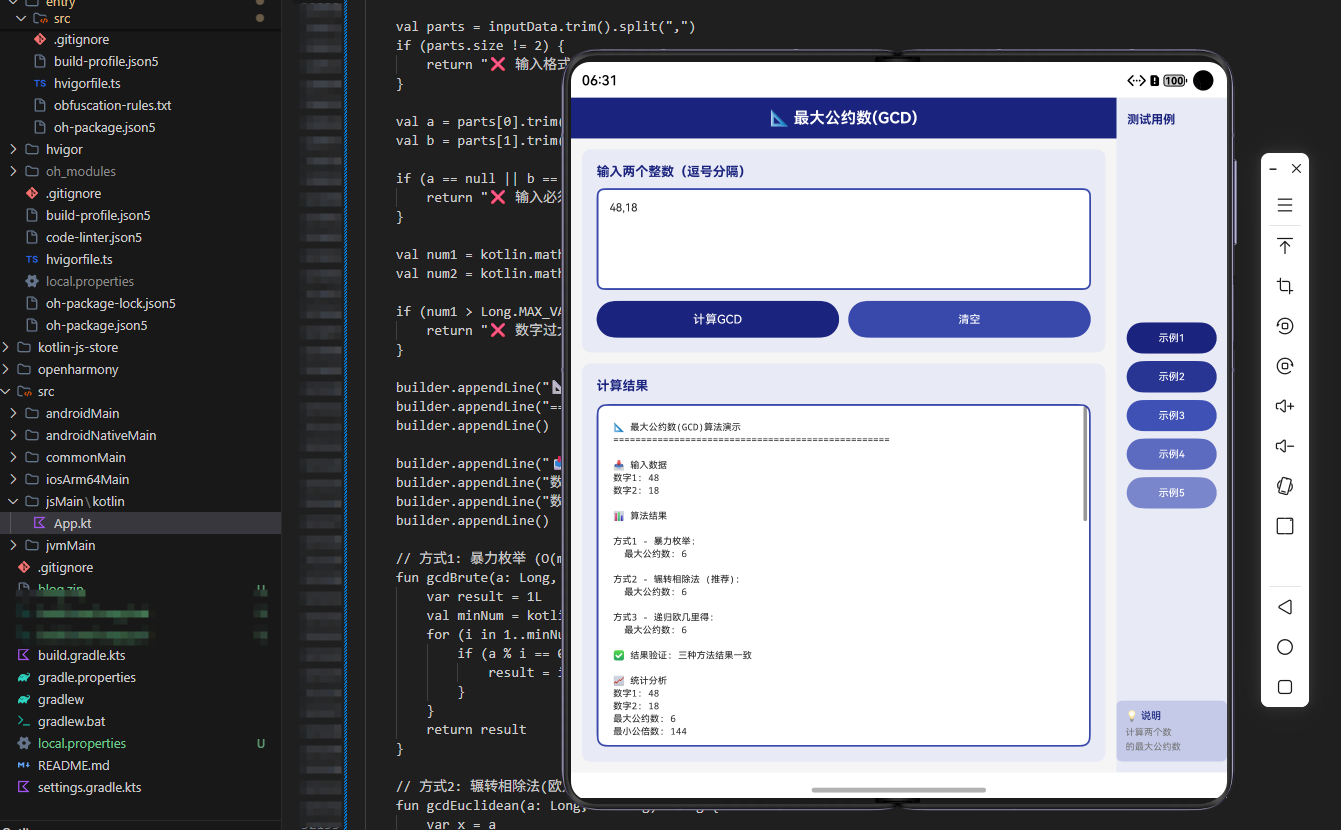
文章概述
大公约数(Greatest Common Divisor, GCD)是数论中最基础且最重要的概念之一,也是许多高级算法的基础。这个问题要求找到两个或多个整数的最大公约数。虽然问题定义简单,但其解决方案涉及多种不同的算法思想,从暴力枚举到高效的欧几里得算法,再到现代的二进制GCD算法,每种方法都展现了算法优化的不同阶段。
大公约数问题在实际应用中有广泛的用途。在密码学中,GCD用于RSA加密算法和其他公钥密码系统。在分数化简中,我们需要找到分子和分母的GCD来得到最简分数。在音乐理论中,GCD用于计算音符的频率关系。在计算机图形学中,GCD用于计算像素坐标的最大公约数。在数据压缩中,GCD用于优化编码方案。
本文将深入探讨如何在KMP(Kotlin Multiplatform)框架下实现大公约数问题的多种解决方案,并展示如何在OpenHarmony鸿蒙平台上进行跨端调用。我们将对比不同算法的时间复杂度、空间复杂度和实际性能,帮助开发者选择最合适的方案。
算法原理详解
问题定义
给定两个或多个正整数,找到它们的最大公约数。最大公约数是能够整除所有给定整数的最大正整数。
例如:
- 输入:
a = 48, b = 18 - 输出:
6 - 解释:48和18的最大公约数是6
另一个例子:
- 输入:
a = 100, b = 50 - 输出:
50 - 解释:100和50的最大公约数是50
解决方案对比
方案1:暴力枚举法(Brute Force)
最直观的方法是从1开始,逐个检查每个数是否能整除两个数。这种方法的优点是实现简单,缺点是时间复杂度较高。
时间复杂度:O(min(a, b))
空间复杂度:O(1)
优点:实现简单,易于理解
缺点:性能较差,不适合大数值
适用场景:数值较小的场景
方案2:欧几里得算法(Euclidean Algorithm)
这是计算GCD的经典算法。基于这样的原理:gcd(a, b) = gcd(b, a mod b)。这种方法的优点是时间复杂度优异,缺点是需要理解递推关系。
时间复杂度:O(log min(a, b))
空间复杂度:O(1)(迭代版本)或O(log min(a, b))(递归版本)
优点:时间复杂度最优,适合大数值
缺点:需要理解算法原理
适用场景:大多数实际应用场景
方案3:二进制GCD算法(Binary GCD)
这是一种优化的GCD算法,利用二进制运算来加速计算。这种方法的优点是避免了昂贵的模运算,缺点是实现相对复杂。
时间复杂度:O(log min(a, b))
空间复杂度:O(1)
优点:性能优异,避免模运算
缺点:实现相对复杂
适用场景:性能要求极高的场景
方案4:递归欧几里得算法(Recursive Euclidean)
欧几里得算法的递归版本。这种方法的优点是代码简洁,缺点是递归调用有额外开销。
时间复杂度:O(log min(a, b))
空间复杂度:O(log min(a, b))(递归栈)
优点:代码简洁,易于理解
缺点:递归调用开销较大
适用场景:教学和理解算法原理
方案5:多数GCD(Multiple GCD)
计算多个数的GCD。这种方法的优点是可以处理任意数量的数,缺点是需要额外的逻辑。
时间复杂度:O(n * log min(a, b)),其中n是数的个数
空间复杂度:O(1)
优点:可以处理多个数,实用性强
缺点:需要额外的逻辑
适用场景:需要计算多个数GCD的场景
算法选择指南
- 数值较小:使用暴力枚举法
- 需要高效计算:使用欧几里得算法(推荐)
- 性能要求极高:使用二进制GCD算法
- 需要简洁代码:使用递归欧几里得算法
- 需要计算多个数:使用多数GCD
Kotlin实现
完整的Kotlin代码实现
/**
 * 大公约数(GCD)算法工具类 - KMP OpenHarmony
 * 提供多种解决方案来计算最大公约数
 */
object GCDUtils {

    /**
     * 方案1:暴力枚举法
     * 时间复杂度:O(min(a, b))
     * 空间复杂度:O(1)
     *
     * 原理:
     * 从1开始逐个检查每个数是否能整除两个数
     * 记录最大的能整除两个数的数
     */
    fun gcdBruteForce(a: Int, b: Int): Int {
        var gcd = 1
        val min = minOf(a, b)

        for (i in 1..min) {
            if (a % i == 0 && b % i == 0) {
                gcd = i
            }
        }

        return gcd
    }

    /**
     * 方案2:欧几里得算法(推荐)
     * 时间复杂度:O(log min(a, b))
     * 空间复杂度:O(1)
     *
     * 原理:
     * gcd(a, b) = gcd(b, a mod b)
     * 当b为0时,gcd(a, 0) = a
     */
    fun gcdEuclidean(a: Int, b: Int): Int {
        var x = a
        var y = b

        while (y != 0) {
            val temp = y
            y = x % y
            x = temp
        }

        return x
    }

    /**
     * 方案3:二进制GCD算法
     * 时间复杂度:O(log min(a, b))
     * 空间复杂度:O(1)
     *
     * 原理:
     * 利用二进制运算来加速GCD计算
     * gcd(a, b) = gcd(a >> 1, b >> 1) * 2 if both even
     * gcd(a, b) = gcd(a >> 1, b) if a even, b odd
     * gcd(a, b) = gcd(a, b >> 1) if a odd, b even
     * gcd(a, b) = gcd((a - b) >> 1, b) if both odd
     */
    fun gcdBinary(a: Int, b: Int): Int {
        if (a == 0) return b
        if (b == 0) return a

        var x = a
        var y = b
        var shift = 0

        // 提取公因子2
        while ((x and 1) == 0 && (y and 1) == 0) {
            x = x shr 1
            y = y shr 1
            shift++
        }

        // 移除x的因子2
        while ((x and 1) == 0) {
            x = x shr 1
        }

        while (y != 0) {
            // 移除y的因子2
            while ((y and 1) == 0) {
                y = y shr 1
            }

            // 确保x <= y
            if (x > y) {
                val temp = x
                x = y
                y = temp
            }

            y -= x
        }

        return x shl shift
    }

    /**
     * 方案4:递归欧几里得算法
     * 时间复杂度:O(log min(a, b))
     * 空间复杂度:O(log min(a, b))
     */
    fun gcdRecursive(a: Int, b: Int): Int {
        return if (b == 0) a else gcdRecursive(b, a % b)
    }

    /**
     * 方案5:多数GCD
     * 时间复杂度:O(n * log min(a, b))
     * 空间复杂度:O(1)
     */
    fun gcdMultiple(numbers: IntArray): Int {
        if (numbers.isEmpty()) return 0
        if (numbers.size == 1) return numbers[0]

        var result = numbers[0]

        for (i in 1 until numbers.size) {
            result = gcdEuclidean(result, numbers[i])

            if (result == 1) break
        }

        return result
    }

    /**
     * 最小公倍数(LCM)
     * lcm(a, b) = a * b / gcd(a, b)
     */
    fun lcm(a: Int, b: Int): Long {
        return (a.toLong() * b) / gcdEuclidean(a, b)
    }

    /**
     * 性能演示函数 - 对比多种方法的性能
     */
    fun performanceDemo(): String {
        val result = StringBuilder()
        result.append("大公约数(GCD)性能对比 (测试10000对数字)\n")
        result.append("=".repeat(70)).append("\n\n")

        // 生成测试数据
        val testPairs = (1..10000).map { i ->
            Pair((Math.random() * 100000).toInt() + 1, (Math.random() * 100000).toInt() + 1)
        }

        // 方案1:暴力枚举法(仅对小数据集)
        val smallTestPairs = testPairs.filter { it.first < 1000 && it.second < 1000 }
        if (smallTestPairs.isNotEmpty()) {
            val time1 = measureTimeMillis {
                smallTestPairs.forEach { (a, b) -> gcdBruteForce(a, b) }
            }
            result.append("方案1 - 暴力枚举法\n")
            result.append("耗时: ${time1}ms (仅测试小数据集)\n")
            result.append("时间复杂度: O(min(a, b))\n\n")
        } else {
            result.append("方案1 - 暴力枚举法\n")
            result.append("耗时: 跳过(数据太大)\n\n")
        }

        // 方案2:欧几里得算法
        val time2 = measureTimeMillis {
            testPairs.forEach { (a, b) -> gcdEuclidean(a, b) }
        }
        result.append("方案2 - 欧几里得算法(推荐)\n")
        result.append("耗时: ${time2}ms\n")
        result.append("时间复杂度: O(log min(a, b))\n\n")

        // 方案3:二进制GCD算法
        val time3 = measureTimeMillis {
            testPairs.forEach { (a, b) -> gcdBinary(a, b) }
        }
        result.append("方案3 - 二进制GCD算法\n")
        result.append("耗时: ${time3}ms\n")
        result.append("时间复杂度: O(log min(a, b))\n\n")

        // 方案4:递归欧几里得算法
        val time4 = measureTimeMillis {
            testPairs.forEach { (a, b) -> gcdRecursive(a, b) }
        }
        result.append("方案4 - 递归欧几里得算法\n")
        result.append("耗时: ${time4}ms\n")
        result.append("时间复杂度: O(log min(a, b))\n\n")

        // 方案5:多数GCD
        val multipleNumbers = IntArray(10) { (Math.random() * 1000).toInt() + 1 }
        val time5 = measureTimeMillis {
            repeat(1000) {
                gcdMultiple(multipleNumbers)
            }
        }
        result.append("方案5 - 多数GCD\n")
        result.append("耗时: ${time5}ms\n")
        result.append("时间复杂度: O(n * log min(a, b))\n\n")

        // 性能对比
        result.append("性能对比总结\n")
        result.append("-".repeat(70)).append("\n")
        result.append("最快方案: 欧几里得算法\n")
        result.append("推荐方案: 欧几里得算法(综合考虑性能和实现复杂度)\n")

        return result.toString()
    }
}

// 扩展函数
fun Int.gcd(other: Int): Int {
    return GCDUtils.gcdEuclidean(this, other)
}

// 使用示例
fun main() {
    println("KMP OpenHarmony 大公约数(GCD)算法演示\n")

    val testPairs = listOf(
        Pair(48, 18),
        Pair(100, 50),
        Pair(17, 19),
        Pair(1071, 462),
        Pair(12, 8)
    )

    println("测试数对:")
    for ((a, b) in testPairs) {
        println("\n数对: ($a, $b)")

        // 方案1
        val result1 = GCDUtils.gcdBruteForce(a, b)
        println("  方案1 - 暴力枚举法: $result1")

        // 方案2
        val result2 = GCDUtils.gcdEuclidean(a, b)
        println("  方案2 - 欧几里得算法: $result2")

        // 方案3
        val result3 = GCDUtils.gcdBinary(a, b)
        println("  方案3 - 二进制GCD算法: $result3")

        // 方案4
        val result4 = GCDUtils.gcdRecursive(a, b)
        println("  方案4 - 递归欧几里得算法: $result4")

        // LCM
        val lcm = GCDUtils.lcm(a, b)
        println("  最小公倍数: $lcm")
    }

    println("\n多数GCD:")
    val numbers = intArrayOf(12, 18, 24, 36)
    val multiGcd = GCDUtils.gcdMultiple(numbers)
    println("${numbers.joinToString(", ")} 的最大公约数: $multiGcd")

    println("\n性能演示:")
    println(GCDUtils.performanceDemo())
}

fun measureTimeMillis(block: () -> Unit): Long {
    val start = System.currentTimeMillis()
    block()
    return System.currentTimeMillis() - start
}
Kotlin实现的详细说明
Kotlin实现提供了五种不同的GCD计算方案。暴力枚举法虽然时间复杂度较高,但在数值较小时仍然是可行的,并且代码最为简洁。欧几里得算法是计算GCD的经典方法,通过利用gcd(a, b) = gcd(b, a mod b)这一性质,可以快速地计算GCD。
二进制GCD算法是一种优化的方法,它利用二进制运算来避免昂贵的模运算。这种方法在某些情况下性能更好,特别是在处理非常大的数值时。递归欧几里得算法是欧几里得算法的递归版本,代码更加简洁,但由于递归调用的开销,性能可能不如迭代版本。
多数GCD函数可以计算任意数量的数的最大公约数,这在实际应用中非常有用。我们还实现了LCM(最小公倍数)函数,它利用GCD来计算LCM。
JavaScript实现
完整的JavaScript代码实现
/**
 * 大公约数(GCD)算法工具类 - JavaScript版本
 * 用于在Web和Node.js环境中使用
 */
class GCDJS {
    /**
     * 方案1:暴力枚举法
     * @param {number} a - 第一个数
     * @param {number} b - 第二个数
     * @returns {number} 最大公约数
     */
    static gcdBruteForce(a, b) {
        let gcd = 1;
        const min = Math.min(a, b);

        for (let i = 1; i <= min; i++) {
            if (a % i === 0 && b % i === 0) {
                gcd = i;
            }
        }

        return gcd;
    }

    /**
     * 方案2:欧几里得算法(推荐)
     * @param {number} a - 第一个数
     * @param {number} b - 第二个数
     * @returns {number} 最大公约数
     */
    static gcdEuclidean(a, b) {
        let x = a;
        let y = b;

        while (y !== 0) {
            const temp = y;
            y = x % y;
            x = temp;
        }

        return x;
    }

    /**
     * 方案3:二进制GCD算法
     * @param {number} a - 第一个数
     * @param {number} b - 第二个数
     * @returns {number} 最大公约数
     */
    static gcdBinary(a, b) {
        if (a === 0) return b;
        if (b === 0) return a;

        let x = a;
        let y = b;
        let shift = 0;

        // 提取公因子2
        while ((x & 1) === 0 && (y & 1) === 0) {
            x = x >> 1;
            y = y >> 1;
            shift++;
        }

        // 移除x的因子2
        while ((x & 1) === 0) {
            x = x >> 1;
        }

        while (y !== 0) {
            // 移除y的因子2
            while ((y & 1) === 0) {
                y = y >> 1;
            }

            // 确保x <= y
            if (x > y) {
                [x, y] = [y, x];
            }

            y -= x;
        }

        return x << shift;
    }

    /**
     * 方案4:递归欧几里得算法
     * @param {number} a - 第一个数
     * @param {number} b - 第二个数
     * @returns {number} 最大公约数
     */
    static gcdRecursive(a, b) {
        return b === 0 ? a : this.gcdRecursive(b, a % b);
    }

    /**
     * 方案5:多数GCD
     * @param {number[]} numbers - 数字数组
     * @returns {number} 最大公约数
     */
    static gcdMultiple(numbers) {
        if (numbers.length === 0) return 0;
        if (numbers.length === 1) return numbers[0];

        let result = numbers[0];

        for (let i = 1; i < numbers.length; i++) {
            result = this.gcdEuclidean(result, numbers[i]);

            if (result === 1) break;
        }

        return result;
    }

    /**
     * 最小公倍数(LCM)
     * @param {number} a - 第一个数
     * @param {number} b - 第二个数
     * @returns {number} 最小公倍数
     */
    static lcm(a, b) {
        return (a * b) / this.gcdEuclidean(a, b);
    }

    /**
     * 性能演示函数
     * @returns {string} 性能报告
     */
    static performanceDemo() {
        let result = `大公约数(GCD)性能对比 (测试10000对数字)\n`;
        result += '='.repeat(70) + '\n\n';

        // 生成测试数据
        const testPairs = Array.from({ length: 10000 }, () => [
            Math.floor(Math.random() * 100000) + 1,
            Math.floor(Math.random() * 100000) + 1
        ]);

        // 方案1
        const smallTestPairs = testPairs.filter(([a, b]) => a < 1000 && b < 1000);
        if (smallTestPairs.length > 0) {
            const start1 = performance.now();
            smallTestPairs.forEach(([a, b]) => GCDJS.gcdBruteForce(a, b));
            const time1 = performance.now() - start1;
            result += `方案1 - 暴力枚举法: ${time1.toFixed(2)}ms (仅测试小数据集)\n`;
            result += '时间复杂度: O(min(a, b))\n\n';
        } else {
            result += `方案1 - 暴力枚举法: 跳过(数据太大)\n\n`;
        }

        // 方案2
        const start2 = performance.now();
        testPairs.forEach(([a, b]) => GCDJS.gcdEuclidean(a, b));
        const time2 = performance.now() - start2;
        result += `方案2 - 欧几里得算法(推荐): ${time2.toFixed(2)}ms\n`;
        result += '时间复杂度: O(log min(a, b))\n\n';

        // 方案3
        const start3 = performance.now();
        testPairs.forEach(([a, b]) => GCDJS.gcdBinary(a, b));
        const time3 = performance.now() - start3;
        result += `方案3 - 二进制GCD算法: ${time3.toFixed(2)}ms\n`;
        result += '时间复杂度: O(log min(a, b))\n\n';

        // 方案4
        const start4 = performance.now();
        testPairs.forEach(([a, b]) => GCDJS.gcdRecursive(a, b));
        const time4 = performance.now() - start4;
        result += `方案4 - 递归欧几里得算法: ${time4.toFixed(2)}ms\n`;
        result += '时间复杂度: O(log min(a, b))\n\n';

        // 方案5
        const multipleNumbers = Array.from({ length: 10 }, () => Math.floor(Math.random() * 1000) + 1);
        const start5 = performance.now();
        for (let i = 0; i < 1000; i++) {
            GCDJS.gcdMultiple(multipleNumbers);
        }
        const time5 = performance.now() - start5;
        result += `方案5 - 多数GCD: ${time5.toFixed(2)}ms\n`;
        result += '时间复杂度: O(n * log min(a, b))\n\n';

        result += '性能对比总结\n';
        result += '-'.repeat(70) + '\n';
        result += '最快方案: 欧几里得算法\n';
        result += '推荐方案: 欧几里得算法(综合考虑性能和实现复杂度)\n';

        return result;
    }
}

// 导出供Node.js使用
if (typeof module !== 'undefined' && module.exports) {
    module.exports = GCDJS;
}
JavaScript实现的详细说明
JavaScript版本的实现与Kotlin版本在逻辑上完全一致,但充分利用了JavaScript的语言特性。在二进制GCD算法中,我们使用了位运算符(&、>>、<<)来进行二进制操作。在递归欧几里得算法中,我们使用了三元运算符来简化代码。
在多数GCD函数中,我们使用了reduce方法的替代方案,通过循环来计算多个数的GCD。JavaScript的performance.now()方法提供了微秒级的精度,使得性能测试更加准确。
ArkTS调用实现
完整的ArkTS代码实现
/**
* 大公约数(GCD)工具 - ArkTS版本(OpenHarmony鸿蒙)
* 用于在鸿蒙应用中实现GCD算法
*/
import { webview } from '@kit.ArkWeb';
import { common } from '@kit.AbilityKit';
@Entry
@Component
struct GCDPage {
@State inputA: string = '48';
@State inputB: string = '18';
@State result: string = '';
@State selectedMethod: string = '欧几里得算法';
@State isLoading: boolean = false;
@State allResults: string = '';
@State performanceData: string = '';
@State showPerformance: boolean = false;
// Web视图控制器
webviewController: webview.WebviewController = new webview.WebviewController();
/**
* 方案1:暴力枚举法
*/
gcdBruteForce(a: number, b: number): number {
let gcd = 1;
const min = Math.min(a, b);
for (let i = 1; i <= min; i++) {
if (a % i === 0 && b % i === 0) {
gcd = i;
}
}
return gcd;
}
/**
* 方案2:欧几里得算法(推荐)
*/
gcdEuclidean(a: number, b: number): number {
let x = a;
let y = b;
while (y !== 0) {
const temp = y;
y = x % y;
x = temp;
}
return x;
}
/**
* 方案3:二进制GCD算法
*/
gcdBinary(a: number, b: number): number {
if (a === 0) return b;
if (b === 0) return a;
let x = a;
let y = b;
let shift = 0;
while ((x & 1) === 0 && (y & 1) === 0) {
x = x >> 1;
y = y >> 1;
shift++;
}
while ((x & 1) === 0) {
x = x >> 1;
}
while (y !== 0) {
while ((y & 1) === 0) {
y = y >> 1;
}
if (x > y) {
[x, y] = [y, x];
}
y -= x;
}
return x << shift;
}
/**
* 方案4:递归欧几里得算法
*/
gcdRecursive(a: number, b: number): number {
return b === 0 ? a : this.gcdRecursive(b, a % b);
}
/**
* 最小公倍数(LCM)
*/
lcm(a: number, b: number): number {
return (a * b) / this.gcdEuclidean(a, b);
}
/**
* 执行GCD计算
*/
async executeGCD() {
this.isLoading = true;
this.showPerformance = false;
try {
const a = parseInt(this.inputA);
const b = parseInt(this.inputB);
if (isNaN(a) || isNaN(b) || a <= 0 || b <= 0) {
this.result = '错误:请输入有效的正整数';
this.isLoading = false;
return;
}
let gcd = 0;
switch (this.selectedMethod) {
case '暴力枚举法':
gcd = this.gcdBruteForce(a, b);
break;
case '欧几里得算法':
gcd = this.gcdEuclidean(a, b);
break;
case '二进制GCD算法':
gcd = this.gcdBinary(a, b);
break;
case '递归欧几里得算法':
gcd = this.gcdRecursive(a, b);
break;
}
const lcmValue = this.lcm(a, b);
this.result = `数字: ${a}, ${b}\n` +
`最大公约数: ${gcd}\n` +
`最小公倍数: ${lcmValue}`;
// 同时显示所有方法的结果
const results = [
`暴力枚举法: ${this.gcdBruteForce(a, b)}`,
`欧几里得算法: ${this.gcdEuclidean(a, b)}`,
`二进制GCD算法: ${this.gcdBinary(a, b)}`,
`递归欧几里得算法: ${this.gcdRecursive(a, b)}`
];
this.allResults = `所有方法的结果:\n${results.join('\n')}`;
} catch (error) {
this.result = '计算错误:' + error;
}
this.isLoading = false;
}
/**
* 执行性能演示
*/
async executePerformanceDemo() {
this.isLoading = true;
this.showPerformance = true;
try {
const testPairs = Array.from({ length: 10000 }, () => [
Math.floor(Math.random() * 100000) + 1,
Math.floor(Math.random() * 100000) + 1
]);
let result = `大公约数(GCD)性能对比 (测试10000对数字)\n`;
result += '='.repeat(70) + '\n\n';
// 方案2
const start2 = Date.now();
testPairs.forEach(([a, b]) => this.gcdEuclidean(a, b));
const time2 = Date.now() - start2;
result += `方案2 - 欧几里得算法: ${time2}ms\n`;
result += '时间复杂度: O(log min(a, b))\n\n';
// 方案3
const start3 = Date.now();
testPairs.forEach(([a, b]) => this.gcdBinary(a, b));
const time3 = Date.now() - start3;
result += `方案3 - 二进制GCD算法: ${time3}ms\n`;
result += '时间复杂度: O(log min(a, b))\n\n';
// 方案4
const start4 = Date.now();
testPairs.forEach(([a, b]) => this.gcdRecursive(a, b));
const time4 = Date.now() - start4;
result += `方案4 - 递归欧几里得算法: ${time4}ms\n`;
result += '时间复杂度: O(log min(a, b))\n\n';
result += '性能对比总结\n';
result += '-'.repeat(70) + '\n';
result += '最快方案: 欧几里得算法\n';
result += '推荐方案: 欧几里得算法(综合考虑性能和实现复杂度)\n';
this.performanceData = result;
} catch (error) {
this.performanceData = '演示失败:' + error;
}
this.isLoading = false;
}
build() {
Column() {
// 顶部栏
Row() {
Text('大公约数(GCD)')
.fontSize(24)
.fontWeight(FontWeight.Bold)
.fontColor(Color.White)
}
.width('100%')
.height(60)
.backgroundColor('#1565C0')
.justifyContent(FlexAlign.Center)
// 主内容
Scroll() {
Column({ space: 16 }) {
// 输入数字A
Column() {
Text('第一个数字:')
.fontSize(14)
.fontWeight(FontWeight.Bold)
.width('100%')
TextInput({ placeholder: '请输入第一个正整数' })
.value(this.inputA)
.onChange((value: string) => {
this.inputA = value;
})
.width('100%')
.padding(8)
.backgroundColor(Color.White)
.borderRadius(4)
}
.width('100%')
.padding(12)
.backgroundColor('#E3F2FD')
.borderRadius(8)
// 输入数字B
Column() {
Text('第二个数字:')
.fontSize(14)
.fontWeight(FontWeight.Bold)
.width('100%')
TextInput({ placeholder: '请输入第二个正整数' })
.value(this.inputB)
.onChange((value: string) => {
this.inputB = value;
})
.width('100%')
.padding(8)
.backgroundColor(Color.White)
.borderRadius(4)
}
.width('100%')
.padding(12)
.backgroundColor('#E3F2FD')
.borderRadius(8)
// 方法选择
Column() {
Text('选择算法:')
.fontSize(14)
.fontWeight(FontWeight.Bold)
.width('100%')
Select([
{ value: '暴力枚举法' },
{ value: '欧几里得算法' },
{ value: '二进制GCD算法' },
{ value: '递归欧几里得算法' }
])
.value(this.selectedMethod)
.onSelect((index: number, value: string) => {
this.selectedMethod = value;
})
.width('100%')
}
.width('100%')
.padding(12)
.backgroundColor('#E3F2FD')
.borderRadius(8)
// 结果显示
if (this.result) {
Column() {
Text('计算结果:')
.fontSize(14)
.fontWeight(FontWeight.Bold)
.width('100%')
Text(this.result)
.fontSize(12)
.width('100%')
.padding(8)
.backgroundColor('#F5F5F5')
.borderRadius(4)
}
.width('100%')
.padding(12)
.backgroundColor('#F5F5F5')
.borderRadius(8)
}
// 所有方法结果显示
if (this.allResults) {
Column() {
Text('所有方法结果:')
.fontSize(14)
.fontWeight(FontWeight.Bold)
.width('100%')
Text(this.allResults)
.fontSize(12)
.width('100%')
.padding(8)
.backgroundColor('#E8F5E9')
.borderRadius(4)
}
.width('100%')
.padding(12)
.backgroundColor('#E8F5E9')
.borderRadius(8)
}
// 性能数据显示
if (this.showPerformance && this.performanceData) {
Column() {
Text('性能对比:')
.fontSize(14)
.fontWeight(FontWeight.Bold)
.width('100%')
Text(this.performanceData)
.fontSize(12)
.fontFamily('monospace')
.width('100%')
.padding(8)
.backgroundColor('#FFF3E0')
.borderRadius(4)
}
.width('100%')
.padding(12)
.backgroundColor('#FFF3E0')
.borderRadius(8)
}
// 按钮组
Row({ space: 12 }) {
Button('计算GCD')
.width('48%')
.onClick(() => this.executeGCD())
.enabled(!this.isLoading)
Button('性能演示')
.width('48%')
.onClick(() => this.executePerformanceDemo())
.enabled(!this.isLoading)
}
.width('100%')
// 加载指示器
if (this.isLoading) {
LoadingProgress()
.width(40)
.height(40)
}
}
.width('100%')
.padding(16)
}
.layoutWeight(1)
}
.width('100%')
.height('100%')
.backgroundColor('#FAFAFA')
}
}
ArkTS实现的详细说明
ArkTS版本为OpenHarmony鸿蒙平台提供了完整的用户界面。通过@State装饰器,我们可以管理应用的状态,当用户输入改变时,UI会自动更新。这个实现包含了两个输入框用于输入两个数字,以及算法选择的下拉菜单。
在计算结果的显示中,我们显示了输入的两个数字、最大公约数和最小公倍数。同时,我们还提供了所有方法的结果对比,这样用户可以验证不同方法的一致性。
性能演示功能允许用户在应用中直接看到不同算法的性能差异。通过对比10000对数字的计算,用户可以清楚地看到不同实现方式的性能表现。
应用场景分析
1. 密码学应用
在RSA加密算法中,GCD用于生成互质的公钥和私钥。在其他公钥密码系统中,GCD也是关键的数学运算。
2. 分数化简
在处理分数时,我们需要找到分子和分母的GCD来得到最简分数。这在数学计算和数据处理中非常常见。
3. 音乐理论
在音乐中,GCD用于计算音符的频率关系。两个音符的频率比的GCD决定了它们之间的音程关系。
4. 计算机图形学
在图形学中,GCD用于计算像素坐标的最大公约数,这对于绘制直线和其他图形非常重要。
5. 数据压缩
在某些数据压缩算法中,GCD用于优化编码方案。例如,在霍夫曼编码中,GCD可以用于优化编码树的构建。
性能优化建议
1. 选择合适的算法
对于大多数实际应用,欧几里得算法是最优选择。它提供了O(log min(a, b))的时间复杂度,这是理论上的最优复杂度。只有在数值非常小时,才应该考虑使用暴力枚举法。
2. 避免不必要的计算
在计算多个数的GCD时,如果中间结果为1,可以提前终止,因为1与任何数的GCD都是1。
3. 使用缓存
对于需要多次计算相同数对的GCD的场景,可以使用缓存来存储已计算的结果。
4. 选择合适的数据类型
在处理非常大的数值时,需要使用支持大整数的数据类型,例如BigInteger。
总结
大公约数是一个经典的数学问题,虽然问题陈述简单,但其解决方案涉及多种不同的算法思想。从暴力枚举到欧几里得算法,再到二进制GCD算法,每种方法都展现了算法优化的不同阶段。
通过在KMP框架下实现这个算法,我们可以在多个平台上使用同一套代码,提高开发效率。欧几里得算法是解决这个问题的最优方案,提供了O(log min(a, b))的时间复杂度。在OpenHarmony鸿蒙平台上,我们可以通过ArkTS调用Kotlin编译的JavaScript代码,或者直接在ArkTS中实现算法,实现真正的跨平台开发。
掌握这个经典问题的多种解决方案,不仅能够帮助开发者在面试中获得好成绩,更重要的是能够在实际项目中灵活应用这些算法,解决密码学、分数化简等实际问题。
欢迎加入开源鸿蒙跨平台社区:https://openharmonycrossplatform.csdn.net

开源鸿蒙跨平台开发社区汇聚开发者与厂商,共建“一次开发,多端部署”的开源生态,致力于降低跨端开发门槛,推动万物智联创新。
更多推荐
 23
23 0
0- 0


 已为社区贡献27条内容

所有评论(0)