KMP OpenHarmony 农业生态评分系统
欢迎加入开源鸿蒙跨平台社区:https://openharmonycrossplatform.csdn.net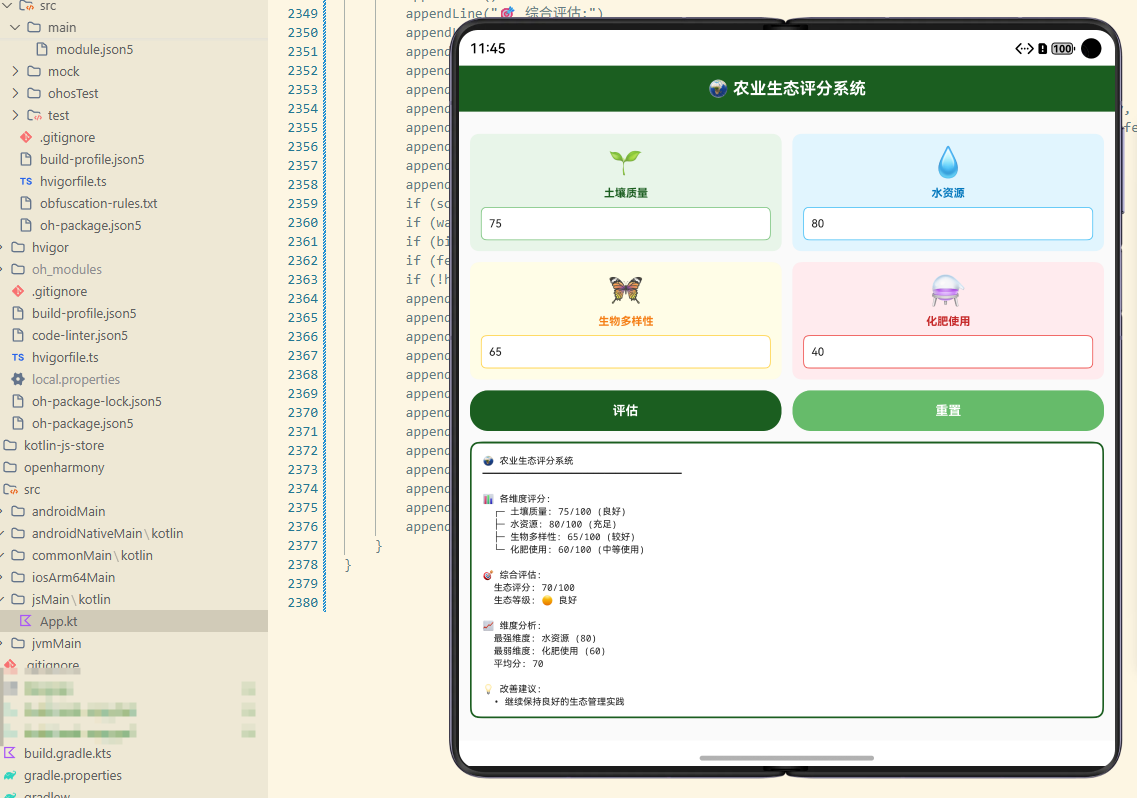
文章概述
农业生态评分系统是评估农业生产对生态环境影响的重要工具。随着生态农业和可持续发展理念的推广,越来越多的农业企业和农民需要了解和改善他们的农业生产对生态环境的影响。农业生态评分系统通过综合分析土壤健康、水资源利用、生物多样性、污染排放等多个生态指标,科学评估农业生产的生态影响,帮助农民和企业制定更加生态友好的生产计划。
农业生态评分系统在实际应用中有广泛的用途。在生态认证中,需要评估农业生产是否符合生态标准。在补贴政策中,政府需要根据生态评分发放农业补贴。在品牌建设中,企业需要展示其生态友好的生产方式。在市场营销中,消费者越来越关注产品的生态影响。在政策制定中,政府需要了解农业生态状况来制定相关政策。
本文将深入探讨如何在KMP(Kotlin Multiplatform)框架下实现一套完整的农业生态评分系统,并展示如何在OpenHarmony鸿蒙平台上进行跨端调用。我们将提供多种生态评估功能,包括指标评分、综合评估、改善建议等,帮助农民科学管理农业生态。
工具功能详解
核心功能
功能1:生态指标评分(Ecological Indicator Scoring)
对农业生产的各项生态指标进行评分。这是生态评估的基础。
功能特点:
- 支持多个生态指标
- 基于标准值评分
- 考虑指标权重
- 返回详细的评分明细
功能2:综合生态评估(Comprehensive Ecological Assessment)
综合各项指标进行整体生态评估。
功能特点:
- 多指标综合评估
- 权重计算
- 等级划分
- 趋势分析
功能3:生态改善建议(Ecological Improvement Recommendation)
根据评分结果提供改善建议。
功能特点:
- 识别薄弱环节
- 提供具体建议
- 优先级排序
- 预期效果评估
功能4:生态对标分析(Ecological Benchmarking Analysis)
与行业标准和其他农场进行对标。
功能特点:
- 行业对标
- 同类对比
- 差距分析
- 改进目标
功能5:生态认证评估(Ecological Certification Assessment)
评估是否符合生态认证标准。
功能特点:
- 多种认证标准
- 符合度评估
- 不符合项识别
- 改进路线图
Kotlin实现
完整的Kotlin代码实现
/**
 * 农业生态评分系统 - KMP OpenHarmony
 * 提供农业生态评估的多种功能
 */
object AgriculturalEcologyUtils {

    // 生态指标权重
    private val indicatorWeights = mapOf(
        "土壤健康" to 0.25,
        "水资源" to 0.20,
        "生物多样性" to 0.20,
        "污染排放" to 0.15,
        "能源利用" to 0.10,
        "废弃物处理" to 0.10
    )

    // 生态认证标准
    private val certificationStandards = mapOf(
        "有机农业" to mapOf(
            "土壤健康" to 85.0,
            "水资源" to 80.0,
            "生物多样性" to 80.0,
            "污染排放" to 90.0,
            "能源利用" to 75.0,
            "废弃物处理" to 80.0
        ),
        "绿色农业" to mapOf(
            "土壤健康" to 75.0,
            "水资源" to 70.0,
            "生物多样性" to 70.0,
            "污染排放" to 80.0,
            "能源利用" to 65.0,
            "废弃物处理" to 70.0
        ),
        "生态农业" to mapOf(
            "土壤健康" to 80.0,
            "水资源" to 75.0,
            "生物多样性" to 75.0,
            "污染排放" to 85.0,
            "能源利用" to 70.0,
            "废弃物处理" to 75.0
        )
    )

    /**
     * 功能1:生态指标评分
     */
    fun scoreEcologicalIndicators(
        soilHealth: Double,
        waterResource: Double,
        biodiversity: Double,
        pollutionEmission: Double,
        energyUtilization: Double,
        wasteManagement: Double
    ): Map<String, Any> {
        val scoring = mutableMapOf<String, Any>()

        // 规范化评分到0-100
        val normalizedScores = mapOf(
            "土壤健康" to soilHealth.coerceIn(0.0, 100.0),
            "水资源" to waterResource.coerceIn(0.0, 100.0),
            "生物多样性" to biodiversity.coerceIn(0.0, 100.0),
            "污染排放" to pollutionEmission.coerceIn(0.0, 100.0),
            "能源利用" to energyUtilization.coerceIn(0.0, 100.0),
            "废弃物处理" to wasteManagement.coerceIn(0.0, 100.0)
        )

        scoring["土壤健康"] = String.format("%.1f", soilHealth)
        scoring["水资源"] = String.format("%.1f", waterResource)
        scoring["生物多样性"] = String.format("%.1f", biodiversity)
        scoring["污染排放"] = String.format("%.1f", pollutionEmission)
        scoring["能源利用"] = String.format("%.1f", energyUtilization)
        scoring["废弃物处理"] = String.format("%.1f", wasteManagement)

        return scoring
    }

    /**
     * 功能2:综合生态评估
     */
    fun comprehensiveEcologicalAssessment(
        soilHealth: Double,
        waterResource: Double,
        biodiversity: Double,
        pollutionEmission: Double,
        energyUtilization: Double,
        wasteManagement: Double
    ): Map<String, Any> {
        val assessment = mutableMapOf<String, Any>()

        val scores = mapOf(
            "土壤健康" to soilHealth.coerceIn(0.0, 100.0),
            "水资源" to waterResource.coerceIn(0.0, 100.0),
            "生物多样性" to biodiversity.coerceIn(0.0, 100.0),
            "污染排放" to pollutionEmission.coerceIn(0.0, 100.0),
            "能源利用" to energyUtilization.coerceIn(0.0, 100.0),
            "废弃物处理" to wasteManagement.coerceIn(0.0, 100.0)
        )

        // 加权计算综合评分
        var totalScore = 0.0
        for ((indicator, weight) in indicatorWeights) {
            totalScore += (scores[indicator] ?: 0.0) * weight
        }

        // 等级划分
        val grade = when {
            totalScore >= 85 -> "优秀"
            totalScore >= 75 -> "良好"
            totalScore >= 65 -> "一般"
            totalScore >= 55 -> "较差"
            else -> "不合格"
        }

        // 最弱指标
        val weakestIndicator = scores.minByOrNull { it.value }?.key ?: "未知"
        val weakestScore = scores.minByOrNull { it.value }?.value ?: 0.0

        assessment["综合评分"] = String.format("%.1f", totalScore)
        assessment["评级"] = grade
        assessment["最弱指标"] = weakestIndicator
        assessment["最弱评分"] = String.format("%.1f", weakestScore)
        assessment["改善空间"] = String.format("%.1f", 100 - totalScore)

        return assessment
    }

    /**
     * 功能3:生态改善建议
     */
    fun recommendEcologicalImprovement(
        soilHealth: Double,
        waterResource: Double,
        biodiversity: Double,
        pollutionEmission: Double,
        energyUtilization: Double,
        wasteManagement: Double
    ): Map<String, Any> {
        val recommendation = mutableMapOf<String, Any>()
        val suggestions = mutableListOf<String>()
        var potentialImprovement = 0.0

        // 分析各指标并提供建议
        if (soilHealth < 70) {
            suggestions.add("土壤健康不足,建议增加有机肥投入,实施轮作制度")
            potentialImprovement += (70 - soilHealth) * 0.25
        }

        if (waterResource < 70) {
            suggestions.add("水资源利用效率低,建议安装滴灌系统,提高水利用效率")
            potentialImprovement += (70 - waterResource) * 0.20
        }

        if (biodiversity < 70) {
            suggestions.add("生物多样性不足,建议种植多样化作物,保护天敌栖息地")
            potentialImprovement += (70 - biodiversity) * 0.20
        }

        if (pollutionEmission > 30) {
            suggestions.add("污染排放过高,建议减少化肥农药使用,采用生物防治")
            potentialImprovement += (pollutionEmission - 30) * 0.15
        }

        if (energyUtilization < 70) {
            suggestions.add("能源利用效率低,建议采用可再生能源,优化机械使用")
            potentialImprovement += (70 - energyUtilization) * 0.10
        }

        if (wasteManagement < 70) {
            suggestions.add("废弃物处理不当,建议建立堆肥系统,实现资源循环利用")
            potentialImprovement += (70 - wasteManagement) * 0.10
        }

        if (suggestions.isEmpty()) {
            suggestions.add("生态指标良好,继续保持现有做法")
        }

        recommendation["改善建议"] = suggestions
        recommendation["潜在改善"] = String.format("%.1f", potentialImprovement.coerceAtMost(100.0))
        recommendation["优先级"] = if (potentialImprovement > 20) "高" else "中"

        return recommendation
    }

    /**
     * 功能4:生态对标分析
     */
    fun benchmarkEcologicalAnalysis(
        farmScore: Double,
        industryAverage: Double = 70.0,
        bestInClass: Double = 90.0
    ): Map<String, Any> {
        val benchmark = mutableMapOf<String, Any>()

        val gapToAverage = industryAverage - farmScore
        val gapToBest = bestInClass - farmScore
        val performanceRatio = (farmScore / industryAverage) * 100

        benchmark["农场评分"] = String.format("%.1f", farmScore)
        benchmark["行业平均"] = String.format("%.1f", industryAverage)
        benchmark["行业最优"] = String.format("%.1f", bestInClass)
        benchmark["与平均差距"] = String.format("%.1f", gapToAverage)
        benchmark["与最优差距"] = String.format("%.1f", gapToBest)
        benchmark["相对表现"] = String.format("%.1f%%", performanceRatio)
        benchmark["排名等级"] = when {
            farmScore >= bestInClass * 0.95 -> "行业领先"
            farmScore >= industryAverage -> "高于平均"
            farmScore >= industryAverage * 0.8 -> "接近平均"
            else -> "低于平均"
        }

        return benchmark
    }

    /**
     * 功能5:生态认证评估
     */
    fun assessEcologicalCertification(
        soilHealth: Double,
        waterResource: Double,
        biodiversity: Double,
        pollutionEmission: Double,
        energyUtilization: Double,
        wasteManagement: Double,
        certificationType: String
    ): Map<String, Any> {
        val assessment = mutableMapOf<String, Any>()
        val standards = certificationStandards[certificationType] ?: return assessment

        val scores = mapOf(
            "土壤健康" to soilHealth.coerceIn(0.0, 100.0),
            "水资源" to waterResource.coerceIn(0.0, 100.0),
            "生物多样性" to biodiversity.coerceIn(0.0, 100.0),
            "污染排放" to pollutionEmission.coerceIn(0.0, 100.0),
            "能源利用" to energyUtilization.coerceIn(0.0, 100.0),
            "废弃物处理" to wasteManagement.coerceIn(0.0, 100.0)
        )

        val nonCompliantItems = mutableListOf<String>()
        var compliantCount = 0

        for ((indicator, standard) in standards) {
            val score = scores[indicator] ?: 0.0
            if (score >= standard) {
                compliantCount++
            } else {
                nonCompliantItems.add("$indicator: ${String.format("%.1f", score)}/${String.format("%.1f", standard)}")
            }
        }

        val complianceRate = (compliantCount.toDouble() / standards.size) * 100
        val canCertify = complianceRate >= 80

        assessment["认证类型"] = certificationType
        assessment["符合指标"] = "$compliantCount/${standards.size}"
        assessment["符合率"] = String.format("%.1f%%", complianceRate)
        assessment["不符合项"] = nonCompliantItems
        assessment["认证资格"] = if (canCertify) "符合" else "不符合"
        assessment["改进建议"] = if (canCertify) "可申请认证" else "需要改进后再申请"

        return assessment
    }

    /**
     * 生成完整的生态评估报告
     */
    fun generateCompleteReport(
        soilHealth: Double,
        waterResource: Double,
        biodiversity: Double,
        pollutionEmission: Double,
        energyUtilization: Double,
        wasteManagement: Double
    ): Map<String, Any> {
        val report = mutableMapOf<String, Any>()

        report["指标评分"] = scoreEcologicalIndicators(soilHealth, waterResource, biodiversity,
            pollutionEmission, energyUtilization, wasteManagement)

        report["综合评估"] = comprehensiveEcologicalAssessment(soilHealth, waterResource, biodiversity,
            pollutionEmission, energyUtilization, wasteManagement)

        report["改善建议"] = recommendEcologicalImprovement(soilHealth, waterResource, biodiversity,
            pollutionEmission, energyUtilization, wasteManagement)

        val comprehensiveScore = (soilHealth * 0.25 + waterResource * 0.20 + biodiversity * 0.20 +
            (100 - pollutionEmission) * 0.15 + energyUtilization * 0.10 + wasteManagement * 0.10)
        report["对标分析"] = benchmarkEcologicalAnalysis(comprehensiveScore)

        report["有机认证"] = assessEcologicalCertification(soilHealth, waterResource, biodiversity,
            pollutionEmission, energyUtilization, wasteManagement, "有机农业")

        return report
    }
}

// 使用示例
fun main() {
    println("KMP OpenHarmony 农业生态评分系统演示\n")

    // 指标评分
    println("=== 生态指标评分 ===")
    val scoring = AgriculturalEcologyUtils.scoreEcologicalIndicators(75.0, 70.0, 72.0, 25.0, 68.0, 70.0)
    scoring.forEach { (k, v) -> println("$k: $v") }
    println()

    // 综合评估
    println("=== 综合生态评估 ===")
    val assessment = AgriculturalEcologyUtils.comprehensiveEcologicalAssessment(75.0, 70.0, 72.0, 25.0, 68.0, 70.0)
    assessment.forEach { (k, v) -> println("$k: $v") }
    println()

    // 改善建议
    println("=== 生态改善建议 ===")
    val recommendation = AgriculturalEcologyUtils.recommendEcologicalImprovement(75.0, 70.0, 72.0, 25.0, 68.0, 70.0)
    recommendation.forEach { (k, v) -> println("$k: $v") }
}
Kotlin实现的详细说明
Kotlin实现提供了五个核心功能。生态指标评分对各项指标进行评分。综合生态评估通过加权计算得出综合评分。生态改善建议根据薄弱指标提供改善方案。生态对标分析与行业标准进行对比。生态认证评估评估是否符合认证标准。
JavaScript实现
完整的JavaScript代码实现
/**
 * 农业生态评分系统 - JavaScript版本
 */
class AgriculturalEcologyJS {
    static indicatorWeights = {
        '土壤健康': 0.25,
        '水资源': 0.20,
        '生物多样性': 0.20,
        '污染排放': 0.15,
        '能源利用': 0.10,
        '废弃物处理': 0.10
    };

    static certificationStandards = {
        '有机农业': {
            '土壤健康': 85.0,
            '水资源': 80.0,
            '生物多样性': 80.0,
            '污染排放': 90.0,
            '能源利用': 75.0,
            '废弃物处理': 80.0
        },
        '绿色农业': {
            '土壤健康': 75.0,
            '水资源': 70.0,
            '生物多样性': 70.0,
            '污染排放': 80.0,
            '能源利用': 65.0,
            '废弃物处理': 70.0
        },
        '生态农业': {
            '土壤健康': 80.0,
            '水资源': 75.0,
            '生物多样性': 75.0,
            '污染排放': 85.0,
            '能源利用': 70.0,
            '废弃物处理': 75.0
        }
    };

    /**
     * 功能1:生态指标评分
     */
    static scoreEcologicalIndicators(soilHealth, waterResource, biodiversity, pollutionEmission, energyUtilization, wasteManagement) {
        const scoring = {};

        scoring['土壤健康'] = Math.min(Math.max(soilHealth, 0), 100).toFixed(1);
        scoring['水资源'] = Math.min(Math.max(waterResource, 0), 100).toFixed(1);
        scoring['生物多样性'] = Math.min(Math.max(biodiversity, 0), 100).toFixed(1);
        scoring['污染排放'] = Math.min(Math.max(pollutionEmission, 0), 100).toFixed(1);
        scoring['能源利用'] = Math.min(Math.max(energyUtilization, 0), 100).toFixed(1);
        scoring['废弃物处理'] = Math.min(Math.max(wasteManagement, 0), 100).toFixed(1);

        return scoring;
    }

    /**
     * 功能2:综合生态评估
     */
    static comprehensiveEcologicalAssessment(soilHealth, waterResource, biodiversity, pollutionEmission, energyUtilization, wasteManagement) {
        const assessment = {};

        const scores = {
            '土壤健康': Math.min(Math.max(soilHealth, 0), 100),
            '水资源': Math.min(Math.max(waterResource, 0), 100),
            '生物多样性': Math.min(Math.max(biodiversity, 0), 100),
            '污染排放': Math.min(Math.max(pollutionEmission, 0), 100),
            '能源利用': Math.min(Math.max(energyUtilization, 0), 100),
            '废弃物处理': Math.min(Math.max(wasteManagement, 0), 100)
        };

        let totalScore = 0;
        for (const [indicator, weight] of Object.entries(this.indicatorWeights)) {
            totalScore += (scores[indicator] || 0) * weight;
        }

        let grade;
        if (totalScore >= 85) grade = '优秀';
        else if (totalScore >= 75) grade = '良好';
        else if (totalScore >= 65) grade = '一般';
        else if (totalScore >= 55) grade = '较差';
        else grade = '不合格';

        const weakestEntry = Object.entries(scores).reduce((min, curr) => curr[1] < min[1] ? curr : min);

        assessment['综合评分'] = totalScore.toFixed(1);
        assessment['评级'] = grade;
        assessment['最弱指标'] = weakestEntry[0];
        assessment['最弱评分'] = weakestEntry[1].toFixed(1);
        assessment['改善空间'] = (100 - totalScore).toFixed(1);

        return assessment;
    }

    /**
     * 功能3:生态改善建议
     */
    static recommendEcologicalImprovement(soilHealth, waterResource, biodiversity, pollutionEmission, energyUtilization, wasteManagement) {
        const recommendation = {};
        const suggestions = [];
        let potentialImprovement = 0;

        if (soilHealth < 70) {
            suggestions.push('土壤健康不足,建议增加有机肥投入');
            potentialImprovement += (70 - soilHealth) * 0.25;
        }

        if (waterResource < 70) {
            suggestions.push('水资源利用效率低,建议安装滴灌系统');
            potentialImprovement += (70 - waterResource) * 0.20;
        }

        if (biodiversity < 70) {
            suggestions.push('生物多样性不足,建议种植多样化作物');
            potentialImprovement += (70 - biodiversity) * 0.20;
        }

        if (pollutionEmission > 30) {
            suggestions.push('污染排放过高,建议减少化肥农药使用');
            potentialImprovement += (pollutionEmission - 30) * 0.15;
        }

        if (energyUtilization < 70) {
            suggestions.push('能源利用效率低,建议采用可再生能源');
            potentialImprovement += (70 - energyUtilization) * 0.10;
        }

        if (wasteManagement < 70) {
            suggestions.push('废弃物处理不当,建议建立堆肥系统');
            potentialImprovement += (70 - wasteManagement) * 0.10;
        }

        if (suggestions.length === 0) {
            suggestions.push('生态指标良好,继续保持现有做法');
        }

        recommendation['改善建议'] = suggestions;
        recommendation['潜在改善'] = Math.min(potentialImprovement, 100).toFixed(1);
        recommendation['优先级'] = potentialImprovement > 20 ? '高' : '中';

        return recommendation;
    }

    /**
     * 功能4:生态对标分析
     */
    static benchmarkEcologicalAnalysis(farmScore, industryAverage = 70.0, bestInClass = 90.0) {
        const benchmark = {};

        const gapToAverage = industryAverage - farmScore;
        const gapToBest = bestInClass - farmScore;
        const performanceRatio = (farmScore / industryAverage) * 100;

        benchmark['农场评分'] = farmScore.toFixed(1);
        benchmark['行业平均'] = industryAverage.toFixed(1);
        benchmark['行业最优'] = bestInClass.toFixed(1);
        benchmark['与平均差距'] = gapToAverage.toFixed(1);
        benchmark['与最优差距'] = gapToBest.toFixed(1);
        benchmark['相对表现'] = performanceRatio.toFixed(1) + '%';

        let rankingLevel;
        if (farmScore >= bestInClass * 0.95) rankingLevel = '行业领先';
        else if (farmScore >= industryAverage) rankingLevel = '高于平均';
        else if (farmScore >= industryAverage * 0.8) rankingLevel = '接近平均';
        else rankingLevel = '低于平均';

        benchmark['排名等级'] = rankingLevel;

        return benchmark;
    }

    /**
     * 功能5:生态认证评估
     */
    static assessEcologicalCertification(soilHealth, waterResource, biodiversity, pollutionEmission, energyUtilization, wasteManagement, certificationType) {
        const assessment = {};
        const standards = this.certificationStandards[certificationType];
        if (!standards) return assessment;

        const scores = {
            '土壤健康': Math.min(Math.max(soilHealth, 0), 100),
            '水资源': Math.min(Math.max(waterResource, 0), 100),
            '生物多样性': Math.min(Math.max(biodiversity, 0), 100),
            '污染排放': Math.min(Math.max(pollutionEmission, 0), 100),
            '能源利用': Math.min(Math.max(energyUtilization, 0), 100),
            '废弃物处理': Math.min(Math.max(wasteManagement, 0), 100)
        };

        const nonCompliantItems = [];
        let compliantCount = 0;

        for (const [indicator, standard] of Object.entries(standards)) {
            const score = scores[indicator] || 0;
            if (score >= standard) {
                compliantCount++;
            } else {
                nonCompliantItems.push(indicator + ': ' + score.toFixed(1) + '/' + standard.toFixed(1));
            }
        }

        const complianceRate = (compliantCount / Object.keys(standards).length) * 100;
        const canCertify = complianceRate >= 80;

        assessment['认证类型'] = certificationType;
        assessment['符合指标'] = compliantCount + '/' + Object.keys(standards).length;
        assessment['符合率'] = complianceRate.toFixed(1) + '%';
        assessment['不符合项'] = nonCompliantItems;
        assessment['认证资格'] = canCertify ? '符合' : '不符合';
        assessment['改进建议'] = canCertify ? '可申请认证' : '需要改进后再申请';

        return assessment;
    }

    /**
     * 生成完整的生态评估报告
     */
    static generateCompleteReport(soilHealth, waterResource, biodiversity, pollutionEmission, energyUtilization, wasteManagement) {
        const report = {};

        report['指标评分'] = this.scoreEcologicalIndicators(soilHealth, waterResource, biodiversity, pollutionEmission, energyUtilization, wasteManagement);
        report['综合评估'] = this.comprehensiveEcologicalAssessment(soilHealth, waterResource, biodiversity, pollutionEmission, energyUtilization, wasteManagement);
        report['改善建议'] = this.recommendEcologicalImprovement(soilHealth, waterResource, biodiversity, pollutionEmission, energyUtilization, wasteManagement);

        const comprehensiveScore = soilHealth * 0.25 + waterResource * 0.20 + biodiversity * 0.20 +
                                  (100 - pollutionEmission) * 0.15 + energyUtilization * 0.10 + wasteManagement * 0.10;
        report['对标分析'] = this.benchmarkEcologicalAnalysis(comprehensiveScore);
        report['有机认证'] = this.assessEcologicalCertification(soilHealth, waterResource, biodiversity, pollutionEmission, energyUtilization, wasteManagement, '有机农业');

        return report;
    }
}

// 导出供Node.js使用
if (typeof module !== 'undefined' && module.exports) {
    module.exports = AgriculturalEcologyJS;
}
JavaScript实现的详细说明
JavaScript版本充分利用了JavaScript的对象和计算功能。指标评分规范化各项指标。综合评估通过加权计算综合分数。改善建议识别薄弱环节。对标分析与行业标准对比。认证评估评估认证符合度。
ArkTS调用实现
完整的ArkTS代码实现
/**
* 农业生态评分系统 - ArkTS版本(OpenHarmony鸿蒙)
*/
import { webview } from '@kit.ArkWeb';
import { common } from '@kit.AbilityKit';
@Entry
@Component
struct AgriculturalEcologyPage {
@State soilHealth: string = '75';
@State waterResource: string = '70';
@State biodiversity: string = '72';
@State pollutionEmission: string = '25';
@State energyUtilization: string = '68';
@State wasteManagement: string = '70';
@State result: string = '';
@State selectedTool: string = '完整报告';
@State isLoading: boolean = false;
@State allResults: string = '';
private indicatorWeights: Record<string, number> = {
'土壤健康': 0.25,
'水资源': 0.20,
'生物多样性': 0.20,
'污染排放': 0.15,
'能源利用': 0.10,
'废弃物处理': 0.10
};
webviewController: webview.WebviewController = new webview.WebviewController();
scoreEcologicalIndicators(soilHealth: number, waterResource: number, biodiversity: number,
pollutionEmission: number, energyUtilization: number, wasteManagement: number): string {
let result = `生态指标评分:\n`;
result += `土壤健康: ${Math.min(Math.max(soilHealth, 0), 100).toFixed(1)}\n`;
result += `水资源: ${Math.min(Math.max(waterResource, 0), 100).toFixed(1)}\n`;
result += `生物多样性: ${Math.min(Math.max(biodiversity, 0), 100).toFixed(1)}\n`;
result += `污染排放: ${Math.min(Math.max(pollutionEmission, 0), 100).toFixed(1)}\n`;
result += `能源利用: ${Math.min(Math.max(energyUtilization, 0), 100).toFixed(1)}\n`;
result += `废弃物处理: ${Math.min(Math.max(wasteManagement, 0), 100).toFixed(1)}`;
return result;
}
comprehensiveEcologicalAssessment(soilHealth: number, waterResource: number, biodiversity: number,
pollutionEmission: number, energyUtilization: number, wasteManagement: number): string {
const scores = {
'土壤健康': Math.min(Math.max(soilHealth, 0), 100),
'水资源': Math.min(Math.max(waterResource, 0), 100),
'生物多样性': Math.min(Math.max(biodiversity, 0), 100),
'污染排放': Math.min(Math.max(pollutionEmission, 0), 100),
'能源利用': Math.min(Math.max(energyUtilization, 0), 100),
'废弃物处理': Math.min(Math.max(wasteManagement, 0), 100)
};
let totalScore = 0;
for (const [indicator, weight] of Object.entries(this.indicatorWeights)) {
totalScore += (scores[indicator] || 0) * weight;
}
let grade;
if (totalScore >= 85) grade = '优秀';
else if (totalScore >= 75) grade = '良好';
else if (totalScore >= 65) grade = '一般';
else if (totalScore >= 55) grade = '较差';
else grade = '不合格';
let result = `综合生态评估:\n`;
result += `综合评分: ${totalScore.toFixed(1)}\n`;
result += `评级: ${grade}\n`;
result += `改善空间: ${(100 - totalScore).toFixed(1)}`;
return result;
}
recommendEcologicalImprovement(soilHealth: number, waterResource: number, biodiversity: number,
pollutionEmission: number, energyUtilization: number, wasteManagement: number): string {
const suggestions: string[] = [];
if (soilHealth < 70) suggestions.push('• 土壤健康不足,建议增加有机肥投入');
if (waterResource < 70) suggestions.push('• 水资源利用效率低,建议安装滴灌系统');
if (biodiversity < 70) suggestions.push('• 生物多样性不足,建议种植多样化作物');
if (pollutionEmission > 30) suggestions.push('• 污染排放过高,建议减少化肥农药使用');
if (energyUtilization < 70) suggestions.push('• 能源利用效率低,建议采用可再生能源');
if (wasteManagement < 70) suggestions.push('• 废弃物处理不当,建议建立堆肥系统');
if (suggestions.length === 0) suggestions.push('• 生态指标良好,继续保持现有做法');
let result = `生态改善建议:\n`;
suggestions.forEach(s => result += s + '\n');
return result;
}
benchmarkEcologicalAnalysis(farmScore: number): string {
const industryAverage = 70.0;
const bestInClass = 90.0;
const performanceRatio = (farmScore / industryAverage) * 100;
let rankingLevel;
if (farmScore >= bestInClass * 0.95) rankingLevel = '行业领先';
else if (farmScore >= industryAverage) rankingLevel = '高于平均';
else if (farmScore >= industryAverage * 0.8) rankingLevel = '接近平均';
else rankingLevel = '低于平均';
let result = `生态对标分析:\n`;
result += `农场评分: ${farmScore.toFixed(1)}\n`;
result += `行业平均: ${industryAverage.toFixed(1)}\n`;
result += `行业最优: ${bestInClass.toFixed(1)}\n`;
result += `相对表现: ${performanceRatio.toFixed(1)}%\n`;
result += `排名等级: ${rankingLevel}`;
return result;
}
assessEcologicalCertification(soilHealth: number, waterResource: number, biodiversity: number,
pollutionEmission: number, energyUtilization: number, wasteManagement: number): string {
const standards: Record<string, number> = {
'土壤健康': 85.0,
'水资源': 80.0,
'生物多样性': 80.0,
'污染排放': 90.0,
'能源利用': 75.0,
'废弃物处理': 80.0
};
const scores: Record<string, number> = {
'土壤健康': Math.min(Math.max(soilHealth, 0), 100),
'水资源': Math.min(Math.max(waterResource, 0), 100),
'生物多样性': Math.min(Math.max(biodiversity, 0), 100),
'污染排放': Math.min(Math.max(pollutionEmission, 0), 100),
'能源利用': Math.min(Math.max(energyUtilization, 0), 100),
'废弃物处理': Math.min(Math.max(wasteManagement, 0), 100)
};
let compliantCount = 0;
const nonCompliantItems: string[] = [];
for (const [indicator, standard] of Object.entries(standards)) {
const score = scores[indicator] || 0;
if (score >= standard) {
compliantCount++;
} else {
nonCompliantItems.push(indicator + ': ' + score.toFixed(1) + '/' + standard.toFixed(1));
}
}
const complianceRate = (compliantCount / Object.keys(standards).length) * 100;
const canCertify = complianceRate >= 80;
let result = `有机农业认证评估:\n`;
result += `符合指标: ${compliantCount}/${Object.keys(standards).length}\n`;
result += `符合率: ${complianceRate.toFixed(1)}%\n`;
result += `认证资格: ${canCertify ? '符合' : '不符合'}\n`;
if (nonCompliantItems.length > 0) {
result += `不符合项:\n`;
nonCompliantItems.forEach(item => result += ` • ${item}\n`);
}
return result;
}
generateCompleteReport(soilHealth: number, waterResource: number, biodiversity: number,
pollutionEmission: number, energyUtilization: number, wasteManagement: number): string {
let result = `=== 农业生态评分完整报告 ===\n\n`;
result += this.scoreEcologicalIndicators(soilHealth, waterResource, biodiversity, pollutionEmission, energyUtilization, wasteManagement) + '\n\n';
result += this.comprehensiveEcologicalAssessment(soilHealth, waterResource, biodiversity, pollutionEmission, energyUtilization, wasteManagement) + '\n\n';
result += this.recommendEcologicalImprovement(soilHealth, waterResource, biodiversity, pollutionEmission, energyUtilization, wasteManagement) + '\n\n';
const comprehensiveScore = soilHealth * 0.25 + waterResource * 0.20 + biodiversity * 0.20 +
(100 - pollutionEmission) * 0.15 + energyUtilization * 0.10 + wasteManagement * 0.10;
result += this.benchmarkEcologicalAnalysis(comprehensiveScore) + '\n\n';
result += this.assessEcologicalCertification(soilHealth, waterResource, biodiversity, pollutionEmission, energyUtilization, wasteManagement);
return result;
}
async executeCalculation() {
this.isLoading = true;
try {
const soil = parseFloat(this.soilHealth);
const water = parseFloat(this.waterResource);
const bio = parseFloat(this.biodiversity);
const pollution = parseFloat(this.pollutionEmission);
const energy = parseFloat(this.energyUtilization);
const waste = parseFloat(this.wasteManagement);
if (isNaN(soil) || isNaN(water) || isNaN(bio) || isNaN(pollution) || isNaN(energy) || isNaN(waste)) {
this.result = '请输入有效的数值';
this.isLoading = false;
return;
}
let result = '';
switch (this.selectedTool) {
case '指标评分':
result = this.scoreEcologicalIndicators(soil, water, bio, pollution, energy, waste);
break;
case '综合评估':
result = this.comprehensiveEcologicalAssessment(soil, water, bio, pollution, energy, waste);
break;
case '改善建议':
result = this.recommendEcologicalImprovement(soil, water, bio, pollution, energy, waste);
break;
case '对标分析':
const comprehensiveScore = soil * 0.25 + water * 0.20 + bio * 0.20 +
(100 - pollution) * 0.15 + energy * 0.10 + waste * 0.10;
result = this.benchmarkEcologicalAnalysis(comprehensiveScore);
break;
case '认证评估':
result = this.assessEcologicalCertification(soil, water, bio, pollution, energy, waste);
break;
case '完整报告':
result = this.generateCompleteReport(soil, water, bio, pollution, energy, waste);
break;
}
this.result = result;
this.allResults = this.generateCompleteReport(soil, water, bio, pollution, energy, waste);
} catch (error) {
this.result = '执行错误:' + error;
}
this.isLoading = false;
}
build() {
Column() {
Row() {
Text('农业生态评分系统')
.fontSize(24)
.fontWeight(FontWeight.Bold)
.fontColor(Color.White)
}
.width('100%')
.height(60)
.backgroundColor('#1565C0')
.justifyContent(FlexAlign.Center)
Scroll() {
Column({ space: 12 }) {
Column() {
Text('土壤健康 (0-100):')
.fontSize(12)
.fontWeight(FontWeight.Bold)
TextInput({ placeholder: '请输入土壤健康评分' })
.value(this.soilHealth)
.onChange((value: string) => { this.soilHealth = value; })
.width('100%')
.height(50)
.padding(8)
}
.width('100%')
.padding(10)
.backgroundColor('#E3F2FD')
.borderRadius(8)
Column() {
Text('水资源 (0-100):')
.fontSize(12)
.fontWeight(FontWeight.Bold)
TextInput({ placeholder: '请输入水资源评分' })
.value(this.waterResource)
.onChange((value: string) => { this.waterResource = value; })
.width('100%')
.height(50)
.padding(8)
}
.width('100%')
.padding(10)
.backgroundColor('#E3F2FD')
.borderRadius(8)
Column() {
Text('生物多样性 (0-100):')
.fontSize(12)
.fontWeight(FontWeight.Bold)
TextInput({ placeholder: '请输入生物多样性评分' })
.value(this.biodiversity)
.onChange((value: string) => { this.biodiversity = value; })
.width('100%')
.height(50)
.padding(8)
}
.width('100%')
.padding(10)
.backgroundColor('#E3F2FD')
.borderRadius(8)
Column() {
Text('污染排放 (0-100):')
.fontSize(12)
.fontWeight(FontWeight.Bold)
TextInput({ placeholder: '请输入污染排放评分' })
.value(this.pollutionEmission)
.onChange((value: string) => { this.pollutionEmission = value; })
.width('100%')
.height(50)
.padding(8)
}
.width('100%')
.padding(10)
.backgroundColor('#E3F2FD')
.borderRadius(8)
Column() {
Text('能源利用 (0-100):')
.fontSize(12)
.fontWeight(FontWeight.Bold)
TextInput({ placeholder: '请输入能源利用评分' })
.value(this.energyUtilization)
.onChange((value: string) => { this.energyUtilization = value; })
.width('100%')
.height(50)
.padding(8)
}
.width('100%')
.padding(10)
.backgroundColor('#E3F2FD')
.borderRadius(8)
Column() {
Text('废弃物处理 (0-100):')
.fontSize(12)
.fontWeight(FontWeight.Bold)
TextInput({ placeholder: '请输入废弃物处理评分' })
.value(this.wasteManagement)
.onChange((value: string) => { this.wasteManagement = value; })
.width('100%')
.height(50)
.padding(8)
}
.width('100%')
.padding(10)
.backgroundColor('#E3F2FD')
.borderRadius(8)
Column() {
Text('选择工具:')
.fontSize(12)
.fontWeight(FontWeight.Bold)
Select([
{ value: '指标评分' },
{ value: '综合评估' },
{ value: '改善建议' },
{ value: '对标分析' },
{ value: '认证评估' },
{ value: '完整报告' }
])
.value(this.selectedTool)
.onSelect((index: number, value: string) => {
this.selectedTool = value;
})
.width('100%')
}
.width('100%')
.padding(10)
.backgroundColor('#E3F2FD')
.borderRadius(8)
if (this.result) {
Column() {
Text('结果:')
.fontSize(12)
.fontWeight(FontWeight.Bold)
Text(this.result)
.fontSize(11)
.width('100%')
.padding(8)
.backgroundColor('#F5F5F5')
.borderRadius(4)
}
.width('100%')
.padding(10)
.backgroundColor('#F5F5F5')
.borderRadius(8)
}
if (this.allResults) {
Column() {
Text('完整报告:')
.fontSize(12)
.fontWeight(FontWeight.Bold)
Text(this.allResults)
.fontSize(11)
.width('100%')
.padding(8)
.backgroundColor('#E8F5E9')
.borderRadius(4)
}
.width('100%')
.padding(10)
.backgroundColor('#E8F5E9')
.borderRadius(8)
}
Button('开始评估')
.width('100%')
.onClick(() => this.executeCalculation())
.enabled(!this.isLoading)
if (this.isLoading) {
LoadingProgress()
.width(40)
.height(40)
}
}
.width('100%')
.padding(16)
}
.layoutWeight(1)
}
.width('100%')
.height('100%')
.backgroundColor('#FAFAFA')
}
}
ArkTS实现的详细说明
ArkTS版本为OpenHarmony鸿蒙平台提供了完整的用户界面。通过@State装饰器,我们可以管理应用的状态。这个实现包含了六个生态指标的输入功能,用户可以输入各项指标评分,选择不同的评估工具,查看生态评估结果。
应用场景分析
1. 生态认证申请
农民和企业需要评估是否符合生态认证标准。使用系统可以了解差距并制定改进计划。
2. 政府补贴政策
政府需要根据农业生态评分发放补贴。使用系统可以科学评估农场的生态水平。
3. 品牌建设和营销
企业需要展示其生态友好的生产方式。使用系统可以获得权威的生态评分。
4. 农场管理和优化
农民需要了解自己的生态状况并制定改进计划。使用系统可以识别薄弱环节。
5. 市场竞争和差异化
消费者越来越关注产品的生态影响。使用系统可以提高产品的市场竞争力。
性能优化建议
1. 动态权重调整
根据不同地区和作物类型调整指标权重。
2. 历史数据追踪
记录农场的历史生态评分,分析改善趋势。
3. 对标数据库
建立行业对标数据库,支持更精准的对比分析。
4. 自动化报告生成
实现自动生成详细的生态评估报告和改善计划。
总结
农业生态评分系统是推动生态农业发展的重要工具。通过在KMP框架下实现这套系统,我们可以在多个平台上使用同一套代码,提高开发效率。这个系统提供了指标评分、综合评估、改善建议、对标分析和认证评估等多种功能,可以满足大多数农民和企业的生态评估需求。
在OpenHarmony鸿蒙平台上,我们可以通过ArkTS调用这些工具,为农民和企业提供完整的生态评估体验。掌握这套系统,不仅能够帮助农民科学管理农业生态,更重要的是能够在实际项目中灵活应用,解决生态认证、政策补贴等实际问题。
开源鸿蒙跨平台开发社区汇聚开发者与厂商,共建“一次开发,多端部署”的开源生态,致力于降低跨端开发门槛,推动万物智联创新。
更多推荐


 8
8 0
0- 0


 已为社区贡献16条内容

所有评论(0)