2024年Android最全平平无奇Android快速转战Kotlin教程,手把手教学,学不会算我输,2024年最新常用的面试题目
重要知识点
下面是有几位Android行业大佬对应上方技术点整理的一些进阶资料。
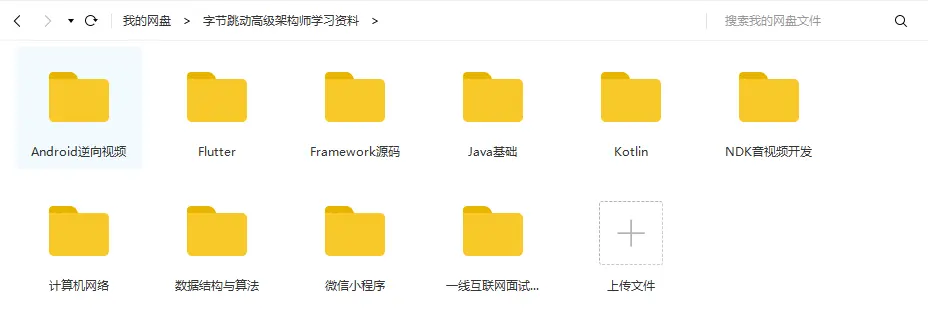
高级进阶篇——高级UI,自定义View(部分展示)
UI这块知识是现今使用者最多的。当年火爆一时的Android入门培训,学会这小块知识就能随便找到不错的工作了。不过很显然现在远远不够了,拒绝无休止的CV,亲自去项目实战,读源码,研究原理吧!
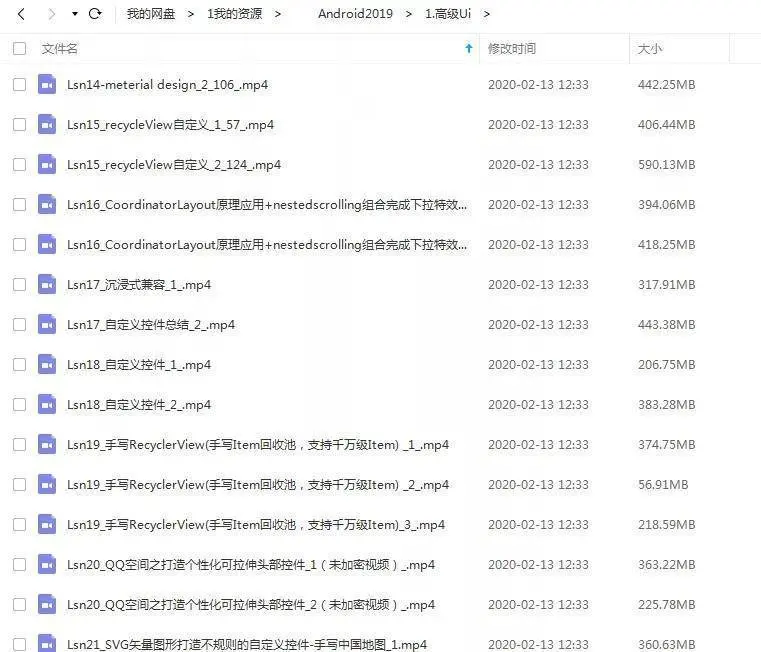
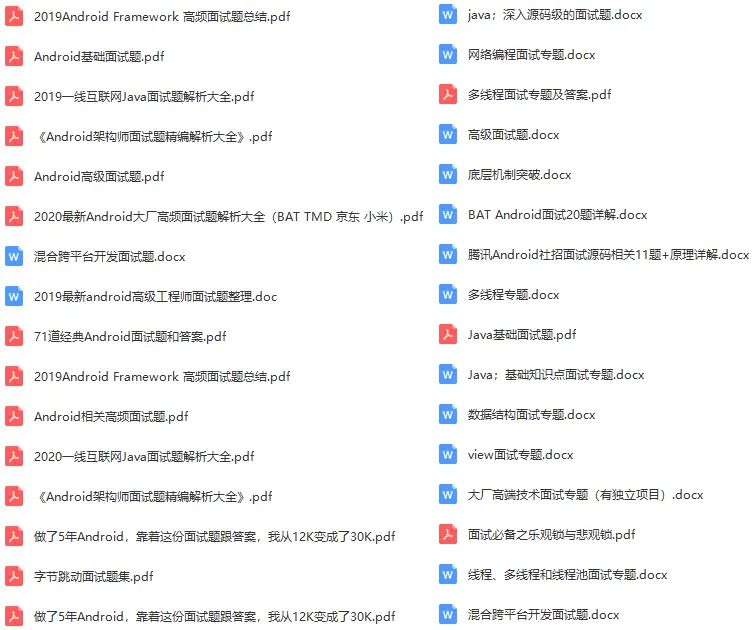
- 面试题部分合集
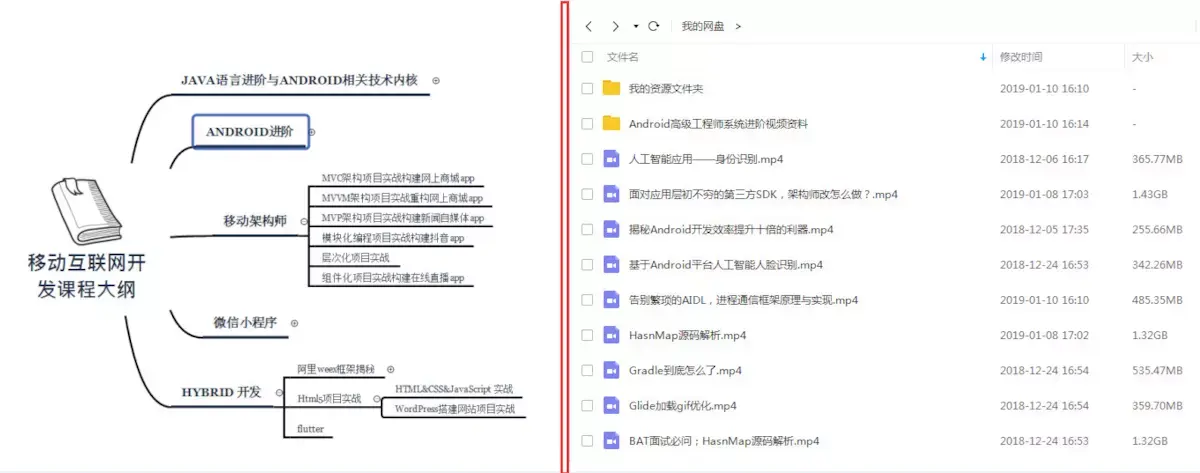
网上学习资料一大堆,但如果学到的知识不成体系,遇到问题时只是浅尝辄止,不再深入研究,那么很难做到真正的技术提升。
一个人可以走的很快,但一群人才能走的更远!不论你是正从事IT行业的老鸟或是对IT行业感兴趣的新人,都欢迎加入我们的的圈子(技术交流、学习资源、职场吐槽、大厂内推、面试辅导),让我们一起学习成长!
},
“error_code”:0
}
再来看一下我的数据类:
data class CalentarDayBean(
val reason: String,
val result: CalentarDayResult,
val error_code: Int
)
data class CalentarDayResult(
val data: CalentarDayData
)
data class CalentarDayData(
val date: String,
val weekday: String,
val animalsYear: String,
val suit: String,
val avoid: String,
val yearMonth: String,
val holiday: String,
val lunar: String,
val lunarYear: String,
val desc: String
)
就是如此方便
7、MVP
kotlin的MVP和java原理一模一样我先定义了IBaseModel和IBaseView
IBaseModel
interface IBaseModel {
fun onDestroy()
fun attachView(view: T)
}
IBaseView
interface IBaseView {
fun showLoading()
fun hideLoading()
fun showMessage(message: String)
fun killMyself()
}
然后完成ICalentarContract,这个类似合同类的接口把P和V的所有方法全部写在一起,看起来代码格外清楚
interface ICalentarContract {
/**
- 对于经常使用的关于UI的方法可以定义到IBaseView中,如显示隐藏进度条,和显示文字消息
*/
interface View : IBaseView {
fun showDayCalentarData(calentarDayBean: CalentarDayBean)
fun showError(errorMsg: String)
}
/**
- Model层定义接口,外部只需关心Model返回的数据,无需关心内部细节,如是否使用缓存
*/
interface Model : IBaseModel<ICalentarContract.View> {
fun getDayCalentarData(date: String)
}
}
然后activity去实现ICalentarContract.View,presenter去实现ICalentarContract.Model
class CalentarDatePresenter : ICalentarContract.Model {
…
}
class MainActivity : AppCompatActivity(), ICalentarContract.View {
…
}
so easy~~~ 到这里我们的Demo就完成了,可以尽情玩乐。
项目地址:待上传。。。。。。。。。。。。。
好了,到这里我们基本掌握了Kotlin在安卓中的应用,那么接下来就需要去学习一下kotlin设计模式以及一些进阶知识~
进阶
一、Kotlin设计模式
本文只列出几个常用的设计模式
1、观察者模式( observer pattern )
Example
interface TextChangedListener {
fun onTextChanged(newText: String)
}
class PrintingTextChangedListener : TextChangedListener {
override fun onTextChanged(newText: String) = println(“Text is changed to: $newText”)
}
class TextView {
var listener: TextChangedListener? = null
var text: String by Delegates.observable(“”) { prop, old, new ->
listener?.onTextChanged(new)
}
}
Usage
val textView = TextView()
textView.listener = PrintingTextChangedListener()
textView.text = “Lorem ipsum”
textView.text = “dolor sit amet”
Output
Text is changed to: Lorem ipsum
Text is changed to: dolor sit amet
2、策略模式( strategy pattern )
Example
class Printer(val stringFormatterStrategy: (String) -> String) {
fun printString(string: String) = println(stringFormatterStrategy.invoke(string))
}
val lowerCaseFormatter: (String) -> String = { it.toLowerCase() }
val upperCaseFormatter = { it: String -> it.toUpperCase() }
Usage
val lowerCasePrinter = Printer(lowerCaseFormatter)
lowerCasePrinter.printString(“LOREM ipsum DOLOR sit amet”)
val upperCasePrinter = Printer(upperCaseFormatter)
upperCasePrinter.printString(“LOREM ipsum DOLOR sit amet”)
val prefixPrinter = Printer({ "Prefix: " + it })
prefixPrinter.printString(“LOREM ipsum DOLOR sit amet”)
Output
lorem ipsum dolor sit amet
LOREM IPSUM DOLOR SIT AMET
Prefix: LOREM ipsum DOLOR sit amet
3、单例模式(singleton pattern)
Example
class Singletone private constructor() {
init {
println(“Initializing with object: $this”)
}
companion object {
val getInstance =SingletonHolder.holder
}
private object SingletonHolder {
val holder = Singletone()
}
fun print() = println(“Printing with object: $this”)
}
Usage
Singletone.getInstance.print()
Singletone.getInstance.print()
Output
Initializing with object: advance.Singletone@266474c2
Printing with object: advance.Singletone@266474c2
Printing with object: advance.Singletone@266474c2
4、工厂模式(Factory Method)
Example
interface Currency {
val code: String
}
class Euro(override val code: String = “EUR”) : Currency
class UnitedStatesDollar(override val code: String = “USD”) : Currency
enum class Country {
UnitedStates, Spain, UK, Greece
}
class CurrencyFactory {
fun currencyForCountry(country: Country): Currency? {
when (country) {
Country.Spain, Country.Greece -> return Euro()
Country.UnitedStates -> return UnitedStatesDollar()
else -> return null
}
}
}
Usage
val noCurrencyCode = “No Currency Code Available”
val greeceCode = CurrencyFactory().currencyForCountry(Country.Greece)?.code() ?: noCurrencyCode
println(“Greece currency: $greeceCode”)
val usCode = CurrencyFactory().currencyForCountry(Country.UnitedStates)?.code() ?: noCurrencyCode
println(“US currency: $usCode”)
val ukCode = CurrencyFactory().currencyForCountry(Country.UK)?.code() ?: noCurrencyCode
println(“UK currency: $ukCode”)
Output
Greece currency: EUR
US currency: USD
UK currency: No Currency Code Available
5、代理模式(Protection Proxy)
Example
interface File {
fun read(name: String)
}
class NormalFile : File {
override fun read(name: String) = println(“Reading file: $name”)
}
//Proxy:
class SecuredFile : File {
val normalFile = NormalFile()
var password: String = “”
override fun read(name: String) {
if (password == “secret”) {
println(“Password is correct: $password”)
normalFile.read(name)
} else {
println(“Incorrect password. Access denied!”)
}
}
}
Usage
val securedFile = SecuredFile()
securedFile.read(“readme.md”)
securedFile.password = “secret”
securedFile.read(“readme.md”)
Output
Incorrect password. Access denied!
Password is correct: secret
Reading file: readme.md
6、建造者模式(builder pattern)
Example
// Let’s assume that Dialog class is provided by external library.
// We have only access to Dialog public interface which cannot be changed.
class Dialog() {
fun showTitle() = println(“showing title”)
fun setTitle(text: String) = println(“setting title text $text”)
fun setTitleColor(color: String) = println(“setting title color $color”)
fun showMessage() = println(“showing message”)
fun setMessage(text: String) = println(“setting message $text”)
fun setMessageColor(color: String) = println(“setting message color $color”)
fun showImage(bitmapBytes: ByteArray) = println(“showing image with size ${bitmapBytes.size}”)
fun show() = println(“showing dialog $this”)
}
//Builder:
class DialogBuilder() {
constructor(init: DialogBuilder.() -> Unit) : this() {
init()
}
private var titleHolder: TextView? = null
private var messageHolder: TextView? = null
private var imageHolder: File? = null
fun title(init: TextView.() -> Unit) {
titleHolder = TextView().apply { init() }
}
fun message(init: TextView.() -> Unit) {
messageHolder = TextView().apply { init() }
}
fun image(init: () -> File) {
imageHolder = init()
}
fun build(): Dialog {
val dialog = Dialog()
titleHolder?.apply {
dialog.setTitle(text)
dialog.setTitleColor(color)
dialog.showTitle()
}
messageHolder?.apply {
dialog.setMessage(text)
dialog.setMessageColor(color)
dialog.showMessage()
}
imageHolder?.apply {
dialog.showImage(readBytes())
}
return dialog
}
class TextView {
var text: String = “”
var color: String = “#00000”
}
}
Usage
//Function that creates dialog builder and builds Dialog
fun dialog(init: DialogBuilder.() -> Unit): Dialog {
return DialogBuilder(init).build()
}
val dialog: Dialog = dialog {
title {
text = “Dialog Title”
}
message {
text = “Dialog Message”
color = “#333333”
}
image {
File.createTempFile(“image”, “jpg”)
}
}
dialog.show()
Output
setting title text Dialog Title
setting title color #00000
showing title
setting message Dialog Message
setting message color #333333
showing message
showing image with size 0
showing dialog Dialog@5f184fc6
2、相关书籍
个人认为还是需要找一本书籍好好地阅读一遍,一下提供了相关书籍可以选择适合自己的。
NO.1
《Kotlin for Android Developers》
Kotlin是编写Android应用程序的新官方语言,多亏了这本书,你很快就能写出代码。直奔主题,实用和完整的例子,它将在开发Android应用程序的同时展示你的语言。学习Kotlin并开始使用这个强大而现代的语言再次享受Android开发。
NO.2
《Kotlin开发快速入门与实战》
学习本书之前不需要具备任何的计算机专业背景,任何有志于APP开发的读者都能利用本书从头学起。
资深软件开发工程师根据Kotlin最新版本撰写,系统讲解Kotlin开发技巧和项目实战。全书共分为7章,内容层次清晰,难度循序渐进。希望通过阅读本书,能够让你成为一个全栈工程师。
NO.3
《疯狂Kotlin讲义》
本书尤其适合从Java转Kotlin的读者,对于没有Java功底的读者,可忽略“对比”部分,直接学习本书也可掌握Kotlin编程。
本书对Kotlin的解读十分系统、全面,超过Kotlin官方文档本身覆盖的内容。本书很多地方都会结合Java字节码进行深入解读,比如对Kotlin扩展的解读,对Kotlin主、次构造器的解读,这种解读目的不止于教会读者简单地掌握Kotlin的用法,而是力求让读者深入理解Kotlin,且更好地理解Java。
NO.4
《Kotlin实战》
本书主要面向有一定Java 经验的开发者。
本书将从语言的基本特性开始,逐渐覆盖其更多的高级特性,尤其注重讲解如何将 Koltin 集成到已有 Java 工程实践及其背后的原理。本书分为两个部分。第一部分讲解如何开始使用 Kotlin 现有的库和API,包括基本语法、扩展函数和扩展属性、数据类和伴生对象、lambda 表达式,以及数据类型系统(着重讲解了可空性和集合的概念)。第二部分教你如何使用 Kotlin 构建自己的 API,以及一些深层次特性——约定和委托属性、高阶函数、泛型、注解和反射,以及领域特定语言的构建。
本书适合广大移动开发者及入门学习者,尤其是紧跟主流趋势的前沿探索者。
NO.5
《揭秘Kotlin编程原理》
本书深入介绍Kotlin面向对象设计的语法特性及其背后的实现方式。
在本书中,读者不仅能清晰地了解Kotlin的语法、高级特性,还能真正地掌握Kotlin背后的实现机制和设计哲学,形成对Kotlin语言既直观、又深刻的认识——在此基础上,读者能准确、快速地上手实践,大大提升自己的移动开发能力。
Kotlin的这些特性和实现机制,可以帮助开发者扫清开发道路上的一些障碍,让开发变得更加简单!本书是一本值得拥有,能切实帮助读者加薪提职的好书!
项目
学习一门语言最快的方式就是看其如何在实际项目中运用,有了上面的基础和进阶,下面我们看一些开源项目:
1.Kotlin-for-Android-Developers(★1676)
介绍:这个项目其实是Kotlin-for-Android-Developers这本书的配套代码,如果你是kotlin的初学者,那么这绝对是你学习kotlin的不二之选。项目通过一个天气的例子很好的展示了kotlin带来的强大功能,比如网络数据的请求,数据的缓存设计,数据库的操作,各种扩展函数的妙用等等。
地址:https://github.com/antoniolg/Kotlin-for-Android-Developers
2.Bandhook-Kotlin (★1494)
介绍:Kotlin版本的音乐播放器,数据来源于LastFm。
地址:https://github.com/antoniolg/Bandhook-Kotlin
3.GankClient-Kotlin (★1216)
介绍:gank.io kotlin实现的干货集中营Android客户端,风格采用了Material Design。
地址:https://github.com/githubwing/GankClient-Kotlin
4.PoiShuhui-Kotlin(★897)
介绍:一个用Kotlin写的简单漫画APP。
地址:https://github.com/wuapnjie/PoiShuhui-Kotlin
5.Eyepetizer-in-Kotlin(★1167)
介绍:Kotlin版本的Eyepetizer客户端
地址:https://github.com/LRH1993/Eyepetizer-in-Kotlin
6.Tucao(★792)
介绍:Kotlin版本的吐槽客户端
地址:https://github.com/blackbbc/Tucao
资源
一、重要资源
Kotlin 官网
https://kotlinlang.org/docs/reference/
Kotlin 官方网站是学习 Kotlin 好去处。在参考部分,你可以找到该语言的所有概念和功能的深入解析文档。在教程部分有关于设置工作环境并使用编译器的实用分步指南。
这里还有个 Kotlin 编译器,是一个浏览器 APP,你可以在上面尝试使用这门语言。它能加载许多示例,包括 Koans 课程 — 这是目前熟悉 Kotlin 语法的最好方式。
Kotlin 官博
https://blog.jetbrains.com/kotlin/
Kotlin 的官方博客由 JetBrains 的一位作者负责。你可以在这里找到所有与 Kotlin 相关的新闻、更新、教程、使用技巧等的内容。
在 Android 上开始使用 Kotlin
https://developer.android.com/kotlin/get-started.html
一篇很牛叉的文章,向我们展示了如何使用 Kotlin 编写和运行 Android 应用程序的测试
从 Java 到 Kotlin
https://github.com/MindorksOpenSource/from-java-to-kotlin
最后的最后
对于程序员来说,要学习的知识内容、技术有太多太多,要想不被环境淘汰就只有不断提升自己,从来都是我们去适应环境,而不是环境来适应我们!
当你有了学习线路,学习哪些内容,也知道以后的路怎么走了,理论看多了总要实践的
最后,互联网不存在所谓的寒冬,只是你没有努力罢了!
网上学习资料一大堆,但如果学到的知识不成体系,遇到问题时只是浅尝辄止,不再深入研究,那么很难做到真正的技术提升。
一个人可以走的很快,但一群人才能走的更远!不论你是正从事IT行业的老鸟或是对IT行业感兴趣的新人,都欢迎加入我们的的圈子(技术交流、学习资源、职场吐槽、大厂内推、面试辅导),让我们一起学习成长!
ndroid 应用程序的测试
从 Java 到 Kotlin
https://github.com/MindorksOpenSource/from-java-to-kotlin
最后的最后
对于程序员来说,要学习的知识内容、技术有太多太多,要想不被环境淘汰就只有不断提升自己,从来都是我们去适应环境,而不是环境来适应我们!
当你有了学习线路,学习哪些内容,也知道以后的路怎么走了,理论看多了总要实践的
[外链图片转存中…(img-faLEaDfl-1714886431293)]
最后,互联网不存在所谓的寒冬,只是你没有努力罢了!
网上学习资料一大堆,但如果学到的知识不成体系,遇到问题时只是浅尝辄止,不再深入研究,那么很难做到真正的技术提升。
一个人可以走的很快,但一群人才能走的更远!不论你是正从事IT行业的老鸟或是对IT行业感兴趣的新人,都欢迎加入我们的的圈子(技术交流、学习资源、职场吐槽、大厂内推、面试辅导),让我们一起学习成长!
开源鸿蒙跨平台开发社区汇聚开发者与厂商,共建“一次开发,多端部署”的开源生态,致力于降低跨端开发门槛,推动万物智联创新。
更多推荐
 7
7 0
0- 0


 已为社区贡献4条内容

所有评论(0)