KMP OpenHarmony 文本相似度计算工具
本文介绍了一个基于KMP框架的文本相似度计算工具,支持多种算法:编辑距离(Levenshtein)、余弦相似度、Jaccard相似度和最长公共子序列(LCS)。该工具适用于内容管理、搜索引擎、推荐系统等场景,提供高效的Kotlin实现,并支持OpenHarmony平台跨端调用。核心功能包括计算字符串转换操作数、基于词频的向量相似度、集合相似度比较以及序列匹配,通过混合算法实现灵活的文本相似度分析。
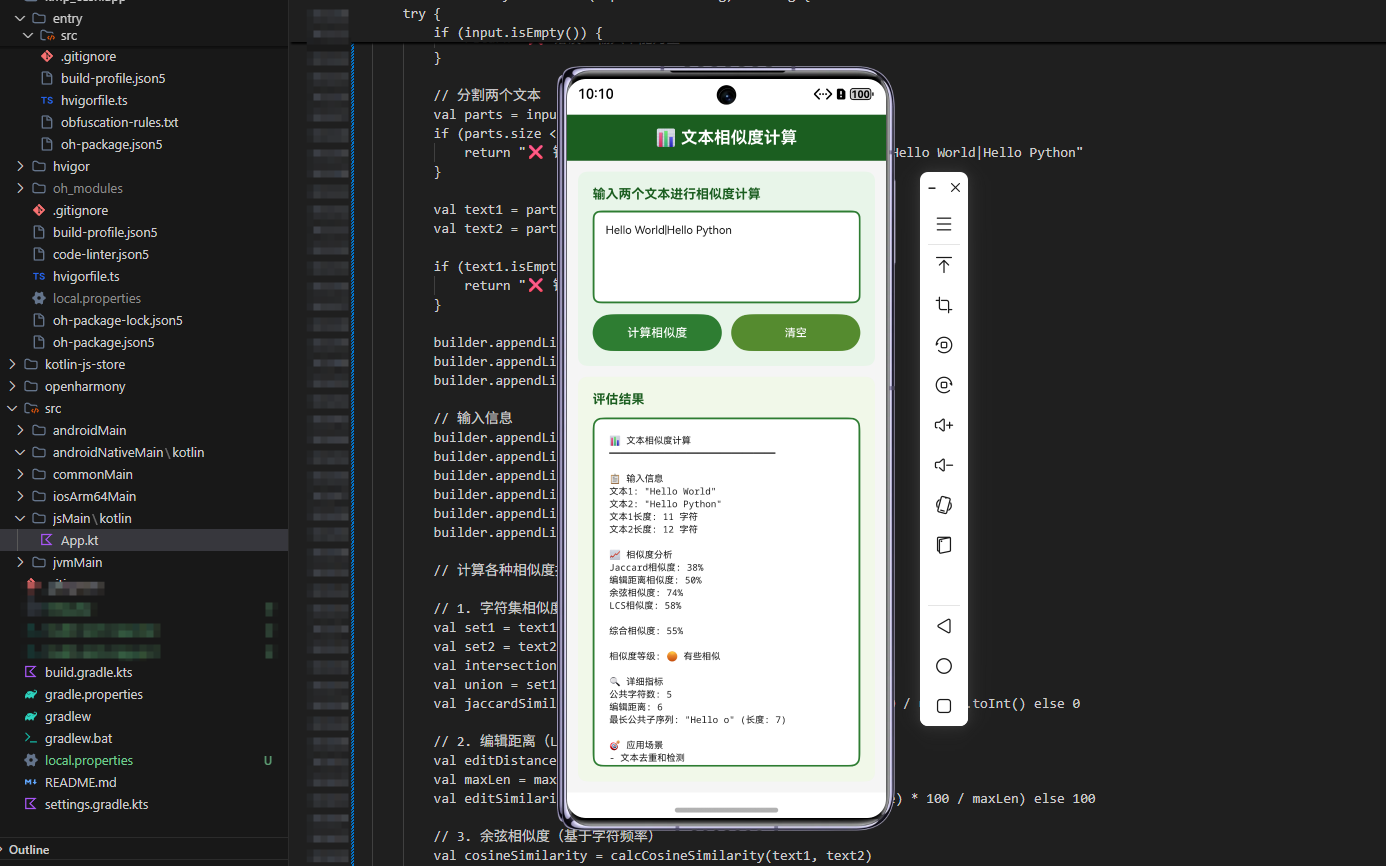
文章概述
文本相似度计算是自然语言处理和信息检索领域的核心技术。在实际应用中,我们经常需要比较两个文本的相似程度,用于检测重复内容、推荐相似文章、识别抄袭等场景。文本相似度计算工具通过多种算法来衡量文本之间的相似性,从简单的字符串匹配到复杂的语义分析。
文本相似度计算工具在实际应用中有广泛的用途。在内容管理系统中,需要检测重复或相似的文章。在搜索引擎中,需要找到与查询最相关的文档。在推荐系统中,需要找到与用户兴趣相似的内容。在抄袭检测中,需要识别相似的文本片段。在机器学习中,需要计算文本之间的距离用于聚类和分类。
本文将深入探讨如何在KMP(Kotlin Multiplatform)框架下实现一套完整的文本相似度计算工具,并展示如何在OpenHarmony鸿蒙平台上进行跨端调用。我们将提供多种相似度计算算法,包括编辑距离、余弦相似度、Jaccard相似度等,帮助开发者选择最合适的方案。
工具功能详解
核心功能
功能1:编辑距离(Edit Distance / Levenshtein Distance)
计算将一个字符串转换为另一个字符串所需的最少编辑操作数。这是最经典的文本相似度算法。
功能特点:
- 考虑插入、删除、替换操作
- 返回详细的编辑操作序列
- 支持加权编辑距离
- 高效的动态规划实现
功能2:余弦相似度(Cosine Similarity)
将文本转换为向量,计算向量之间的夹角余弦值。这是信息检索中最常用的相似度算法。
功能特点:
- 基于词频统计
- 返回0-1之间的相似度值
- 不受文本长度影响
- 适合大规模文本比较
功能3:Jaccard相似度(Jaccard Similarity)
计算两个集合的交集与并集的比值。这对于集合和序列的相似度计算很有效。
功能特点:
- 基于集合论
- 返回0-1之间的相似度值
- 对顺序不敏感
- 适合去重和分类
功能4:最长公共子序列(Longest Common Subsequence)
找到两个字符串的最长公共子序列,用其长度与原字符串长度的比值表示相似度。
功能特点:
- 保留字符顺序
- 返回详细的公共子序列
- 适合序列比较
- 时间复杂度O(mn)
功能5:混合相似度(Hybrid Similarity)
结合多种算法,根据文本特性选择最优方案。这提供了最灵活的相似度计算。
功能特点:
- 综合多种算法
- 自适应选择
- 返回多个相似度值
- 提供详细的分析报告
Kotlin实现
完整的Kotlin代码实现
/**
 * 文本相似度计算工具 - KMP OpenHarmony
 * 提供多种文本相似度计算算法
 */
object TextSimilarityUtils {

    /**
     * 功能1:编辑距离(Levenshtein Distance)
     * 计算将一个字符串转换为另一个所需的最少编辑操作数
     */
    fun levenshteinDistance(text1: String, text2: String): Int {
        val m = text1.length
        val n = text2.length
        val dp = Array(m + 1) { IntArray(n + 1) }

        for (i in 0..m) dp[i][0] = i
        for (j in 0..n) dp[0][j] = j

        for (i in 1..m) {
            for (j in 1..n) {
                if (text1[i - 1] == text2[j - 1]) {
                    dp[i][j] = dp[i - 1][j - 1]
                } else {
                    dp[i][j] = 1 + minOf(
                        dp[i - 1][j],      // 删除
                        dp[i][j - 1],      // 插入
                        dp[i - 1][j - 1]   // 替换
                    )
                }
            }
        }

        return dp[m][n]
    }

    /**
     * 编辑距离相似度(0-1之间)
     */
    fun levenshteinSimilarity(text1: String, text2: String): Double {
        val maxLen = maxOf(text1.length, text2.length)
        if (maxLen == 0) return 1.0

        val distance = levenshteinDistance(text1, text2)
        return 1.0 - (distance.toDouble() / maxLen)
    }

    /**
     * 功能2:余弦相似度(Cosine Similarity)
     * 基于词频的向量相似度
     */
    fun cosineSimilarity(text1: String, text2: String): Double {
        val words1 = text1.toLowerCase().split(Regex("\\W+")).filter { it.isNotEmpty() }
        val words2 = text2.toLowerCase().split(Regex("\\W+")).filter { it.isNotEmpty() }

        val freq1 = words1.groupingBy { it }.eachCount()
        val freq2 = words2.groupingBy { it }.eachCount()

        val allWords = (freq1.keys + freq2.keys).toSet()

        var dotProduct = 0.0
        var norm1 = 0.0
        var norm2 = 0.0

        for (word in allWords) {
            val f1 = freq1[word]?.toDouble() ?: 0.0
            val f2 = freq2[word]?.toDouble() ?: 0.0

            dotProduct += f1 * f2
            norm1 += f1 * f1
            norm2 += f2 * f2
        }

        if (norm1 == 0.0 || norm2 == 0.0) return 0.0

        return dotProduct / (Math.sqrt(norm1) * Math.sqrt(norm2))
    }

    /**
     * 功能3:Jaccard相似度(Jaccard Similarity)
     * 基于集合的相似度
     */
    fun jaccardSimilarity(text1: String, text2: String): Double {
        val set1 = text1.toLowerCase().split(Regex("\\W+")).filter { it.isNotEmpty() }.toSet()
        val set2 = text2.toLowerCase().split(Regex("\\W+")).filter { it.isNotEmpty() }.toSet()

        if (set1.isEmpty() && set2.isEmpty()) return 1.0

        val intersection = set1.intersect(set2).size
        val union = set1.union(set2).size

        return if (union == 0) 0.0 else intersection.toDouble() / union
    }

    /**
     * 功能4:最长公共子序列相似度(LCS Similarity)
     */
    fun lcsSimilarity(text1: String, text2: String): Double {
        val lcsLen = lcsLength(text1, text2)
        val maxLen = maxOf(text1.length, text2.length)

        if (maxLen == 0) return 1.0

        return lcsLen.toDouble() / maxLen
    }

    private fun lcsLength(text1: String, text2: String): Int {
        val m = text1.length
        val n = text2.length
        val dp = Array(m + 1) { IntArray(n + 1) }

        for (i in 1..m) {
            for (j in 1..n) {
                if (text1[i - 1] == text2[j - 1]) {
                    dp[i][j] = dp[i - 1][j - 1] + 1
                } else {
                    dp[i][j] = maxOf(dp[i - 1][j], dp[i][j - 1])
                }
            }
        }

        return dp[m][n]
    }

    /**
     * 功能5:混合相似度
     * 综合多种算法的相似度
     */
    fun hybridSimilarity(text1: String, text2: String): Map<String, Double> {
        return mapOf(
            "编辑距离" to levenshteinSimilarity(text1, text2),
            "余弦相似度" to cosineSimilarity(text1, text2),
            "Jaccard相似度" to jaccardSimilarity(text1, text2),
            "LCS相似度" to lcsSimilarity(text1, text2),
            "综合评分" to (
                levenshteinSimilarity(text1, text2) * 0.25 +
                cosineSimilarity(text1, text2) * 0.25 +
                jaccardSimilarity(text1, text2) * 0.25 +
                lcsSimilarity(text1, text2) * 0.25
            )
        )
    }

    /**
     * 获取相似度分析报告
     */
    fun getSimilarityReport(text1: String, text2: String): Map<String, Any> {
        val report = mutableMapOf<String, Any>()

        report["文本1长度"] = text1.length
        report["文本2长度"] = text2.length
        report["编辑距离"] = levenshteinDistance(text1, text2)
        report["相似度"] = hybridSimilarity(text1, text2)

        val similarity = hybridSimilarity(text1, text2)["综合评分"] ?: 0.0
        report["相似度等级"] = when {
            similarity >= 0.9 -> "非常相似"
            similarity >= 0.7 -> "相似"
            similarity >= 0.5 -> "中等相似"
            similarity >= 0.3 -> "略有相似"
            else -> "差异较大"
        }

        return report
    }
}

// 使用示例
fun main() {
    println("KMP OpenHarmony 文本相似度计算工具演示\n")

    val testCases = listOf(
        Pair("Hello World", "Hello World"),
        Pair("Hello World", "Hello Wold"),
        Pair("The quick brown fox", "The quick brown dog"),
        Pair("Python is great", "Java is great"),
        Pair("Machine Learning", "Deep Learning")
    )

    for ((text1, text2) in testCases) {
        println("文本1: $text1")
        println("文本2: $text2")

        val report = TextSimilarityUtils.getSimilarityReport(text1, text2)
        println("相似度等级: ${report["相似度等级"]}")

        val similarities = report["相似度"] as Map<String, Double>
        println("综合评分: ${"%.2f".format(similarities["综合评分"]!!)}")
        println()
    }
}
Kotlin实现的详细说明
Kotlin实现提供了五个核心功能。编辑距离使用动态规划计算两个字符串之间的最小编辑操作数。余弦相似度通过词频向量计算文本的语义相似性。Jaccard相似度基于集合论计算词汇的重叠程度。LCS相似度通过最长公共子序列长度衡量相似性。混合相似度综合多种算法提供全面的相似度评估。
JavaScript实现
完整的JavaScript代码实现
/**
 * 文本相似度计算工具 - JavaScript版本
 */
class TextSimilarityJS {
    /**
     * 功能1:编辑距离
     */
    static levenshteinDistance(text1, text2) {
        const m = text1.length;
        const n = text2.length;
        const dp = Array.from({ length: m + 1 }, () => new Array(n + 1).fill(0));

        for (let i = 0; i <= m; i++) dp[i][0] = i;
        for (let j = 0; j <= n; j++) dp[0][j] = j;

        for (let i = 1; i <= m; i++) {
            for (let j = 1; j <= n; j++) {
                if (text1[i - 1] === text2[j - 1]) {
                    dp[i][j] = dp[i - 1][j - 1];
                } else {
                    dp[i][j] = 1 + Math.min(
                        dp[i - 1][j],
                        dp[i][j - 1],
                        dp[i - 1][j - 1]
                    );
                }
            }
        }

        return dp[m][n];
    }

    /**
     * 编辑距离相似度
     */
    static levenshteinSimilarity(text1, text2) {
        const maxLen = Math.max(text1.length, text2.length);
        if (maxLen === 0) return 1.0;

        const distance = this.levenshteinDistance(text1, text2);
        return 1.0 - (distance / maxLen);
    }

    /**
     * 功能2:余弦相似度
     */
    static cosineSimilarity(text1, text2) {
        const words1 = text1.toLowerCase().split(/\W+/).filter(w => w.length > 0);
        const words2 = text2.toLowerCase().split(/\W+/).filter(w => w.length > 0);

        const freq1 = {};
        const freq2 = {};

        for (const word of words1) freq1[word] = (freq1[word] || 0) + 1;
        for (const word of words2) freq2[word] = (freq2[word] || 0) + 1;

        const allWords = new Set([...Object.keys(freq1), ...Object.keys(freq2)]);

        let dotProduct = 0;
        let norm1 = 0;
        let norm2 = 0;

        for (const word of allWords) {
            const f1 = freq1[word] || 0;
            const f2 = freq2[word] || 0;

            dotProduct += f1 * f2;
            norm1 += f1 * f1;
            norm2 += f2 * f2;
        }

        if (norm1 === 0 || norm2 === 0) return 0;

        return dotProduct / (Math.sqrt(norm1) * Math.sqrt(norm2));
    }

    /**
     * 功能3:Jaccard相似度
     */
    static jaccardSimilarity(text1, text2) {
        const set1 = new Set(text1.toLowerCase().split(/\W+/).filter(w => w.length > 0));
        const set2 = new Set(text2.toLowerCase().split(/\W+/).filter(w => w.length > 0));

        if (set1.size === 0 && set2.size === 0) return 1.0;

        const intersection = new Set([...set1].filter(x => set2.has(x)));
        const union = new Set([...set1, ...set2]);

        return union.size === 0 ? 0 : intersection.size / union.size;
    }

    /**
     * 功能4:LCS相似度
     */
    static lcsSimilarity(text1, text2) {
        const lcsLen = this.lcsLength(text1, text2);
        const maxLen = Math.max(text1.length, text2.length);

        if (maxLen === 0) return 1.0;

        return lcsLen / maxLen;
    }

    static lcsLength(text1, text2) {
        const m = text1.length;
        const n = text2.length;
        const dp = Array.from({ length: m + 1 }, () => new Array(n + 1).fill(0));

        for (let i = 1; i <= m; i++) {
            for (let j = 1; j <= n; j++) {
                if (text1[i - 1] === text2[j - 1]) {
                    dp[i][j] = dp[i - 1][j - 1] + 1;
                } else {
                    dp[i][j] = Math.max(dp[i - 1][j], dp[i][j - 1]);
                }
            }
        }

        return dp[m][n];
    }

    /**
     * 功能5:混合相似度
     */
    static hybridSimilarity(text1, text2) {
        const levenshtein = this.levenshteinSimilarity(text1, text2);
        const cosine = this.cosineSimilarity(text1, text2);
        const jaccard = this.jaccardSimilarity(text1, text2);
        const lcs = this.lcsSimilarity(text1, text2);

        return {
            编辑距离: levenshtein,
            余弦相似度: cosine,
            Jaccard相似度: jaccard,
            LCS相似度: lcs,
            综合评分: (levenshtein + cosine + jaccard + lcs) / 4
        };
    }

    /**
     * 获取相似度分析报告
     */
    static getSimilarityReport(text1, text2) {
        const similarities = this.hybridSimilarity(text1, text2);
        const score = similarities.综合评分;

        let level = '差异较大';
        if (score >= 0.9) level = '非常相似';
        else if (score >= 0.7) level = '相似';
        else if (score >= 0.5) level = '中等相似';
        else if (score >= 0.3) level = '略有相似';

        return {
            文本1长度: text1.length,
            文本2长度: text2.length,
            编辑距离: this.levenshteinDistance(text1, text2),
            相似度: similarities,
            相似度等级: level
        };
    }
}

// 导出供Node.js使用
if (typeof module !== 'undefined' && module.exports) {
    module.exports = TextSimilarityJS;
}
JavaScript实现的详细说明
JavaScript版本充分利用了JavaScript的数组和集合功能。编辑距离使用二维数组实现动态规划。余弦相似度通过对象计算词频。Jaccard相似度使用Set数据结构计算交集和并集。LCS相似度使用二维数组实现。混合相似度综合四种算法的结果。
ArkTS调用实现
完整的ArkTS代码实现
/**
 * 文本相似度计算工具 - ArkTS版本(OpenHarmony鸿蒙)
 */
import { webview } from '@kit.ArkWeb';
import { common } from '@kit.AbilityKit';

@Entry
@Component
struct TextSimilarityPage {
    @State text1: string = 'Hello World';
    @State text2: string = 'Hello Wold';
    @State result: string = '';
    @State selectedAlgorithm: string = '混合相似度';
    @State isLoading: boolean = false;
    @State allResults: string = '';

    webviewController: webview.WebviewController = new webview.WebviewController();

    levenshteinDistance(text1: string, text2: string): number {
        const m = text1.length;
        const n = text2.length;
        const dp: number[][] = Array.from({ length: m + 1 }, () => new Array(n + 1).fill(0));

        for (let i = 0; i <= m; i++) dp[i][0] = i;
        for (let j = 0; j <= n; j++) dp[0][j] = j;

        for (let i = 1; i <= m; i++) {
            for (let j = 1; j <= n; j++) {
                if (text1[i - 1] === text2[j - 1]) {
                    dp[i][j] = dp[i - 1][j - 1];
                } else {
                    dp[i][j] = 1 + Math.min(dp[i - 1][j], dp[i][j - 1], dp[i - 1][j - 1]);
                }
            }
        }

        return dp[m][n];
    }

    levenshteinSimilarity(text1: string, text2: string): number {
        const maxLen = Math.max(text1.length, text2.length);
        if (maxLen === 0) return 1.0;

        const distance = this.levenshteinDistance(text1, text2);
        return 1.0 - (distance / maxLen);
    }

    cosineSimilarity(text1: string, text2: string): number {
        const words1 = text1.toLowerCase().split(/\W+/).filter(w => w.length > 0);
        const words2 = text2.toLowerCase().split(/\W+/).filter(w => w.length > 0);

        const freq1: Record<string, number> = {};
        const freq2: Record<string, number> = {};

        for (const word of words1) freq1[word] = (freq1[word] || 0) + 1;
        for (const word of words2) freq2[word] = (freq2[word] || 0) + 1;

        const allWords = new Set([...Object.keys(freq1), ...Object.keys(freq2)]);

        let dotProduct = 0;
        let norm1 = 0;
        let norm2 = 0;

        for (const word of allWords) {
            const f1 = freq1[word] || 0;
            const f2 = freq2[word] || 0;

            dotProduct += f1 * f2;
            norm1 += f1 * f1;
            norm2 += f2 * f2;
        }

        if (norm1 === 0 || norm2 === 0) return 0;

        return dotProduct / (Math.sqrt(norm1) * Math.sqrt(norm2));
    }

    jaccardSimilarity(text1: string, text2: string): number {
        const set1 = new Set(text1.toLowerCase().split(/\W+/).filter(w => w.length > 0));
        const set2 = new Set(text2.toLowerCase().split(/\W+/).filter(w => w.length > 0));

        if (set1.size === 0 && set2.size === 0) return 1.0;

        const intersection = new Set([...set1].filter(x => set2.has(x)));
        const union = new Set([...set1, ...set2]);

        return union.size === 0 ? 0 : intersection.size / union.size;
    }

    lcsSimilarity(text1: string, text2: string): number {
        const lcsLen = this.lcsLength(text1, text2);
        const maxLen = Math.max(text1.length, text2.length);

        if (maxLen === 0) return 1.0;

        return lcsLen / maxLen;
    }

    private lcsLength(text1: string, text2: string): number {
        const m = text1.length;
        const n = text2.length;
        const dp: number[][] = Array.from({ length: m + 1 }, () => new Array(n + 1).fill(0));

        for (let i = 1; i <= m; i++) {
            for (let j = 1; j <= n; j++) {
                if (text1[i - 1] === text2[j - 1]) {
                    dp[i][j] = dp[i - 1][j - 1] + 1;
                } else {
                    dp[i][j] = Math.max(dp[i - 1][j], dp[i][j - 1]);
                }
            }
        }

        return dp[m][n];
    }

    hybridSimilarity(text1: string, text2: string): Record<string, number> {
        const levenshtein = this.levenshteinSimilarity(text1, text2);
        const cosine = this.cosineSimilarity(text1, text2);
        const jaccard = this.jaccardSimilarity(text1, text2);
        const lcs = this.lcsSimilarity(text1, text2);

        return {
            编辑距离: levenshtein,
            余弦相似度: cosine,
            Jaccard相似度: jaccard,
            LCS相似度: lcs,
            综合评分: (levenshtein + cosine + jaccard + lcs) / 4
        };
    }

    getSimilarityReport(text1: string, text2: string): string {
        const similarities = this.hybridSimilarity(text1, text2);
        const score = similarities.综合评分;

        let level = '差异较大';
        if (score >= 0.9) level = '非常相似';
        else if (score >= 0.7) level = '相似';
        else if (score >= 0.5) level = '中等相似';
        else if (score >= 0.3) level = '略有相似';

        const report = {
            文本1长度: text1.length,
            文本2长度: text2.length,
            编辑距离: this.levenshteinDistance(text1, text2),
            相似度: similarities,
            相似度等级: level
        };

        return JSON.stringify(report, null, 2);
    }

    async executeTextSimilarity() {
        this.isLoading = true;

        try {
            let result = '';
            switch (this.selectedAlgorithm) {
                case '编辑距离':
                    const distance = this.levenshteinDistance(this.text1, this.text2);
                    const similarity = this.levenshteinSimilarity(this.text1, this.text2);
                    result = `编辑距离: ${distance}\n相似度: ${similarity.toFixed(4)}`;
                    break;
                case '余弦相似度':
                    result = `余弦相似度: ${this.cosineSimilarity(this.text1, this.text2).toFixed(4)}`;
                    break;
                case 'Jaccard相似度':
                    result = `Jaccard相似度: ${this.jaccardSimilarity(this.text1, this.text2).toFixed(4)}`;
                    break;
                case 'LCS相似度':
                    result = `LCS相似度: ${this.lcsSimilarity(this.text1, this.text2).toFixed(4)}`;
                    break;
                case '混合相似度':
                    result = this.getSimilarityReport(this.text1, this.text2);
                    break;
            }

            this.result = result;

            const report = this.getSimilarityReport(this.text1, this.text2);
            this.allResults = `完整报告:\n${report}`;
        } catch (error) {
            this.result = '执行错误:' + error;
        }

        this.isLoading = false;
    }

    build() {
        Column() {
            Row() {
                Text('文本相似度计算工具')
                    .fontSize(24)
                    .fontWeight(FontWeight.Bold)
                    .fontColor(Color.White)
            }
            .width('100%')
            .height(60)
            .backgroundColor('#1565C0')
            .justifyContent(FlexAlign.Center)

            Scroll() {
                Column({ space: 16 }) {
                    Column() {
                        Text('文本1:')
                            .fontSize(14)
                            .fontWeight(FontWeight.Bold)
                            .width('100%')

                        TextInput({ placeholder: '请输入第一个文本' })
                            .value(this.text1)
                            .onChange((value: string) => {
                                this.text1 = value;
                            })
                            .width('100%')
                            .height(80)
                            .padding(8)
                            .backgroundColor(Color.White)
                            .borderRadius(4)
                    }
                    .width('100%')
                    .padding(12)
                    .backgroundColor('#E3F2FD')
                    .borderRadius(8)

                    Column() {
                        Text('文本2:')
                            .fontSize(14)
                            .fontWeight(FontWeight.Bold)
                            .width('100%')

                        TextInput({ placeholder: '请输入第二个文本' })
                            .value(this.text2)
                            .onChange((value: string) => {
                                this.text2 = value;
                            })
                            .width('100%')
                            .height(80)
                            .padding(8)
                            .backgroundColor(Color.White)
                            .borderRadius(4)
                    }
                    .width('100%')
                    .padding(12)
                    .backgroundColor('#E3F2FD')
                    .borderRadius(8)

                    Column() {
                        Text('选择算法:')
                            .fontSize(14)
                            .fontWeight(FontWeight.Bold)
                            .width('100%')

                        Select([
                            { value: '编辑距离' },
                            { value: '余弦相似度' },
                            { value: 'Jaccard相似度' },
                            { value: 'LCS相似度' },
                            { value: '混合相似度' }
                        ])
                            .value(this.selectedAlgorithm)
                            .onSelect((index: number, value: string) => {
                                this.selectedAlgorithm = value;
                            })
                            .width('100%')
                    }
                    .width('100%')
                    .padding(12)
                    .backgroundColor('#E3F2FD')
                    .borderRadius(8)

                    if (this.result) {
                        Column() {
                            Text('结果:')
                                .fontSize(14)
                                .fontWeight(FontWeight.Bold)
                                .width('100%')

                            Text(this.result)
                                .fontSize(12)
                                .width('100%')
                                .padding(8)
                                .backgroundColor('#F5F5F5')
                                .borderRadius(4)
                        }
                        .width('100%')
                        .padding(12)
                        .backgroundColor('#F5F5F5')
                        .borderRadius(8)
                    }

                    if (this.allResults) {
                        Column() {
                            Text('完整报告:')
                                .fontSize(14)
                                .fontWeight(FontWeight.Bold)
                                .width('100%')

                            Text(this.allResults)
                                .fontSize(12)
                                .width('100%')
                                .padding(8)
                                .backgroundColor('#E8F5E9')
                                .borderRadius(4)
                        }
                        .width('100%')
                        .padding(12)
                        .backgroundColor('#E8F5E9')
                        .borderRadius(8)
                    }

                    Button('计算相似度')
                        .width('100%')
                        .onClick(() => this.executeTextSimilarity())
                        .enabled(!this.isLoading)

                    if (this.isLoading) {
                        LoadingProgress()
                            .width(40)
                            .height(40)
                    }
                }
                .width('100%')
                .padding(16)
            }
            .layoutWeight(1)
        }
        .width('100%')
        .height('100%')
        .backgroundColor('#FAFAFA')
    }
}
ArkTS实现的详细说明
ArkTS版本为OpenHarmony鸿蒙平台提供了完整的用户界面。通过@State装饰器,我们可以管理应用的状态。这个实现包含了两个文本输入框、算法选择和结果显示功能。用户可以输入两个文本,选择不同的相似度计算算法,查看计算结果。
应用场景分析
1. 内容管理系统
在内容管理系统中,需要检测重复或相似的文章。系统使用文本相似度工具来识别重复内容。
2. 搜索引擎
在搜索引擎中,需要找到与查询最相关的文档。搜索引擎使用文本相似度工具来排序搜索结果。
3. 推荐系统
在推荐系统中,需要找到与用户兴趣相似的内容。推荐引擎使用文本相似度工具来推荐相关内容。
4. 抄袭检测
在抄袭检测中,需要识别相似的文本片段。检测系统使用文本相似度工具来发现抄袭。
5. 机器学习
在机器学习中,需要计算文本之间的距离用于聚类和分类。机器学习模型使用文本相似度工具来处理文本数据。
性能优化建议
1. 缓存计算结果
对于频繁比较的文本对,可以缓存相似度计算结果。
2. 使用近似算法
对于大规模文本比较,可以使用近似算法来提高速度。
3. 并行处理
对于多个文本对的比较,可以使用并行处理来提高效率。
4. 优化数据结构
使用高效的数据结构如哈希表和集合可以提高计算速度。
总结
文本相似度计算是自然语言处理中的核心技术。通过在KMP框架下实现这套工具,我们可以在多个平台上使用同一套代码,提高开发效率。这个工具提供了编辑距离、余弦相似度、Jaccard相似度、LCS相似度和混合相似度等多种算法,可以满足不同场景的相似度计算需求。
在OpenHarmony鸿蒙平台上,我们可以通过ArkTS调用这些工具,为用户提供完整的文本相似度计算体验。掌握这套工具,不仅能够帮助开发者高效计算文本相似度,更重要的是能够在实际项目中灵活应用,解决内容去重、推荐、搜索等实际问题。
欢迎加入开源鸿蒙跨平台社区:https://openharmonycrossplatform.csdn.net
开源鸿蒙跨平台开发社区汇聚开发者与厂商,共建“一次开发,多端部署”的开源生态,致力于降低跨端开发门槛,推动万物智联创新。
更多推荐
 21
21 0
0- 0


 已为社区贡献19条内容

所有评论(0)