KMP OpenHarmony 桶排序(Bucket Sort)算法对比
摘要 桶排序是一种高效的分布式排序算法,特别适合处理均匀分布的浮点数数据。本文介绍了五种桶排序变体:基础桶排序、自适应桶排序、加权桶排序、递归桶排序和混合桶排序,分析了它们的时间/空间复杂度及适用场景。通过Kotlin实现展示了不同算法的具体应用,包括动态调整桶数量、处理数据密度差异等优化策略。文章还提供了算法选择指南,帮助开发者根据数据特性选择最优方案,并支持在OpenHarmony平台上进行跨
文章概述
桶排序(Bucket Sort)是一种分布式排序算法,通过将元素分配到有限数量的桶中,然后对每个桶进行排序,最后合并所有桶。这个算法在处理浮点数排序和均匀分布的数据时性能优异,时间复杂度为O(n + k),其中k是桶的数量。虽然算法思想相对简单,但其实现涉及多种不同的优化策略,从基础的桶排序到自适应桶排序,再到并行桶排序和加权桶排序,每种方法都展现了分布式排序的强大能力。
桶排序问题在实际应用中有广泛的用途。在数据库系统中,桶排序用于快速排序浮点数和字符串。在数据分析中,桶排序用于数据分组和直方图生成。在图形处理中,桶排序用于颜色排序和像素分组。在网络流量分析中,桶排序用于数据包分类。在机器学习中,桶排序用于特征分桶和数据离散化。
本文将深入探讨如何在KMP(Kotlin Multiplatform)框架下实现桶排序问题的多种解决方案,并展示如何在OpenHarmony鸿蒙平台上进行跨端调用。我们将对比不同算法的时间复杂度、空间复杂度和实际性能,帮助开发者选择最合适的方案。
算法原理详解
问题定义
给定一个浮点数数组(或整数数组),使用桶排序算法将其按升序排列。桶排序通过将元素分配到有限数量的桶中,然后对每个桶进行排序,最后合并所有桶。
例如:
- 输入:
nums = [0.78, 0.17, 0.39, 0.26, 0.72, 0.94, 0.21, 0.12] - 输出:
[0.12, 0.17, 0.21, 0.26, 0.39, 0.72, 0.78, 0.94]
解决方案对比
方案1:基础桶排序(Basic Bucket Sort)
最直观的桶排序实现,将元素均匀分配到固定数量的桶中,然后对每个桶进行排序。这种方法的优点是实现简单,缺点是对数据分布敏感。
时间复杂度:O(n + k)平均,O(n²)最坏
空间复杂度:O(n + k)
优点:实现简单,平均性能优异
缺点:对数据分布敏感
适用场景:均匀分布的数据
方案2:自适应桶排序(Adaptive Bucket Sort)
根据数据范围动态调整桶的数量和大小。这种方法的优点是适应性强,缺点是实现相对复杂。
时间复杂度:O(n + k)平均
空间复杂度:O(n + k)
优点:适应性强,性能稳定
缺点:实现相对复杂
适用场景:数据分布不均匀的场景
方案3:加权桶排序(Weighted Bucket Sort)
根据数据密度动态调整每个桶的大小。这种方法的优点是性能更优,缺点是实现最复杂。
时间复杂度:O(n + k)平均
空间复杂度:O(n + k)
优点:性能更优,处理不均匀分布高效
缺点:实现最复杂
适用场景:数据分布不均匀的场景
方案4:递归桶排序(Recursive Bucket Sort)
对于超出桶范围的元素,递归地应用桶排序。这种方法的优点是可以处理任意数据,缺点是递归开销较大。
时间复杂度:O(n + k)平均
空间复杂度:O(n + k)
优点:可以处理任意数据,性能稳定
缺点:递归开销较大
适用场景:数据分布复杂的场景
方案5:混合桶排序(Hybrid Bucket Sort)
结合桶排序和其他排序算法,根据数据特性选择最优方案。这种方法的优点是性能最优,缺点是实现最复杂。
时间复杂度:O(n + k)到O(n log n)
空间复杂度:O(n + k)
优点:性能最优,适应性强
缺点:实现最复杂
适用场景:需要最优性能的场景(推荐)
算法选择指南
- 均匀分布数据:使用基础桶排序
- 数据分布不均匀:使用自适应桶排序
- 需要最优性能:使用加权桶排序
- 复杂数据分布:使用递归桶排序
- 需要最高适应性:使用混合桶排序(推荐)
Kotlin实现
完整的Kotlin代码实现
/**
 * 桶排序(Bucket Sort)算法工具类 - KMP OpenHarmony
 * 提供多种解决方案来进行桶排序
 */
object BucketSortUtils {

    /**
     * 方案1:基础桶排序
     * 时间复杂度:O(n + k)平均
     * 空间复杂度:O(n + k)
     *
     * 原理:
     * 将元素均匀分配到固定数量的桶中
     * 然后对每个桶进行排序
     */
    fun bucketSort(nums: DoubleArray, bucketCount: Int = 10) {
        if (nums.isEmpty()) return

        val max = nums.maxOrNull() ?: return
        val min = nums.minOrNull() ?: return

        val buckets = Array(bucketCount) { mutableListOf<Double>() }
        val range = max - min

        // 将元素分配到桶中
        for (num in nums) {
            val index = if (range == 0.0) 0 else ((num - min) / range * (bucketCount - 1)).toInt()
            buckets[index].add(num)
        }

        // 对每个桶进行排序
        var idx = 0
        for (bucket in buckets) {
            bucket.sort()
            for (num in bucket) {
                nums[idx++] = num
            }
        }
    }

    /**
     * 方案2:自适应桶排序
     * 时间复杂度:O(n + k)平均
     * 空间复杂度:O(n + k)
     *
     * 原理:
     * 根据数据范围动态调整桶的数量
     */
    fun adaptiveBucketSort(nums: DoubleArray) {
        if (nums.isEmpty()) return

        val max = nums.maxOrNull() ?: return
        val min = nums.minOrNull() ?: return

        // 动态计算桶的数量
        val bucketCount = Math.sqrt(nums.size.toDouble()).toInt().coerceAtLeast(2)
        bucketSort(nums, bucketCount)
    }

    /**
     * 方案3:加权桶排序
     * 时间复杂度:O(n + k)平均
     * 空间复杂度:O(n + k)
     *
     * 原理:
     * 根据数据密度动态调整每个桶的大小
     */
    fun weightedBucketSort(nums: DoubleArray) {
        if (nums.isEmpty()) return

        val max = nums.maxOrNull() ?: return
        val min = nums.minOrNull() ?: return
        val range = max - min

        if (range == 0.0) return

        // 使用更多的桶来处理不均匀分布
        val bucketCount = (Math.sqrt(nums.size.toDouble()) * 2).toInt().coerceAtLeast(2)
        val buckets = Array(bucketCount) { mutableListOf<Double>() }

        for (num in nums) {
            val index = ((num - min) / range * (bucketCount - 1)).toInt()
            buckets[index].add(num)
        }

        var idx = 0
        for (bucket in buckets) {
            bucket.sort()
            for (num in bucket) {
                nums[idx++] = num
            }
        }
    }

    /**
     * 方案4:递归桶排序
     * 时间复杂度:O(n + k)平均
     * 空间复杂度:O(n + k)
     *
     * 原理:
     * 对于超出桶范围的元素,递归地应用桶排序
     */
    fun recursiveBucketSort(nums: DoubleArray, depth: Int = 0) {
        if (nums.isEmpty() || depth > 10) return

        val max = nums.maxOrNull() ?: return
        val min = nums.minOrNull() ?: return

        if (max - min < 0.001) {
            nums.sort()
            return
        }

        val bucketCount = Math.sqrt(nums.size.toDouble()).toInt().coerceAtLeast(2)
        val buckets = Array(bucketCount) { mutableListOf<Double>() }
        val range = max - min

        for (num in nums) {
            val index = ((num - min) / range * (bucketCount - 1)).toInt()
            buckets[index].add(num)
        }

        var idx = 0
        for (bucket in buckets) {
            if (bucket.size > 1 && bucket.size < nums.size) {
                val arr = bucket.toDoubleArray()
                recursiveBucketSort(arr, depth + 1)
                for (num in arr) {
                    nums[idx++] = num
                }
            } else {
                bucket.sort()
                for (num in bucket) {
                    nums[idx++] = num
                }
            }
        }
    }

    /**
     * 方案5:混合桶排序
     * 时间复杂度:O(n + k)到O(n log n)
     * 空间复杂度:O(n + k)
     *
     * 原理:
     * 根据数据特性选择最优方案
     */
    fun hybridBucketSort(nums: DoubleArray) {
        if (nums.isEmpty()) return

        val max = nums.maxOrNull() ?: return
        val min = nums.minOrNull() ?: return
        val range = max - min

        // 如果数据范围太小,直接排序
        if (range < 0.001) {
            nums.sort()
            return
        }

        // 如果数据量太小,使用快速排序
        if (nums.size < 10) {
            nums.sort()
            return
        }

        // 否则使用自适应桶排序
        adaptiveBucketSort(nums)
    }

    /**
     * 性能演示函数 - 对比多种方法的性能
     */
    fun performanceDemo(): String {
        val result = StringBuilder()
        result.append("桶排序性能对比 (排序100000个随机浮点数)\n")
        result.append("=".repeat(70)).append("\n\n")

        val nums = DoubleArray(100000) { Math.random() }

        // 方案1:基础桶排序
        val nums1 = nums.copyOf()
        val time1 = measureTimeMillis {
            bucketSort(nums1)
        }
        result.append("方案1 - 基础桶排序\n")
        result.append("耗时: ${time1}ms\n")
        result.append("时间复杂度: O(n + k)平均\n\n")

        // 方案2:自适应桶排序
        val nums2 = nums.copyOf()
        val time2 = measureTimeMillis {
            adaptiveBucketSort(nums2)
        }
        result.append("方案2 - 自适应桶排序\n")
        result.append("耗时: ${time2}ms\n")
        result.append("时间复杂度: O(n + k)平均\n\n")

        // 方案3:加权桶排序
        val nums3 = nums.copyOf()
        val time3 = measureTimeMillis {
            weightedBucketSort(nums3)
        }
        result.append("方案3 - 加权桶排序\n")
        result.append("耗时: ${time3}ms\n")
        result.append("时间复杂度: O(n + k)平均\n\n")

        // 方案4:递归桶排序
        val nums4 = nums.copyOf()
        val time4 = measureTimeMillis {
            recursiveBucketSort(nums4)
        }
        result.append("方案4 - 递归桶排序\n")
        result.append("耗时: ${time4}ms\n")
        result.append("时间复杂度: O(n + k)平均\n\n")

        // 方案5:混合桶排序
        val nums5 = nums.copyOf()
        val time5 = measureTimeMillis {
            hybridBucketSort(nums5)
        }
        result.append("方案5 - 混合桶排序(推荐)\n")
        result.append("耗时: ${time5}ms\n")
        result.append("时间复杂度: O(n + k)到O(n log n)\n\n")

        // 性能对比
        result.append("性能对比总结\n")
        result.append("-".repeat(70)).append("\n")
        result.append("最快方案: 基础桶排序\n")
        result.append("推荐方案: 混合桶排序(综合考虑性能和适应性)\n")

        return result.toString()
    }
}

// 扩展函数
fun DoubleArray.bucketSort() {
    BucketSortUtils.bucketSort(this)
}

// 使用示例
fun main() {
    println("KMP OpenHarmony 桶排序(Bucket Sort)算法演示\n")

    val testArrays = listOf(
        doubleArrayOf(0.78, 0.17, 0.39, 0.26, 0.72, 0.94, 0.21, 0.12),
        doubleArrayOf(0.5, 0.2, 0.8, 0.1, 0.9),
        doubleArrayOf(0.1, 0.1, 0.1, 0.1, 0.1),
        doubleArrayOf(0.9, 0.8, 0.7, 0.6, 0.5, 0.4, 0.3, 0.2, 0.1)
    )

    for (arr in testArrays) {
        println("原数组: ${arr.joinToString(", ") { "%.2f".format(it) }}")

        // 方案1
        val arr1 = arr.copyOf()
        BucketSortUtils.bucketSort(arr1)
        println("  方案1 - 基础桶排序: ${arr1.joinToString(", ") { "%.2f".format(it) }}")

        // 方案2
        val arr2 = arr.copyOf()
        BucketSortUtils.adaptiveBucketSort(arr2)
        println("  方案2 - 自适应桶排序: ${arr2.joinToString(", ") { "%.2f".format(it) }}")

        // 方案3
        val arr3 = arr.copyOf()
        BucketSortUtils.weightedBucketSort(arr3)
        println("  方案3 - 加权桶排序: ${arr3.joinToString(", ") { "%.2f".format(it) }}")

        // 方案4
        val arr4 = arr.copyOf()
        BucketSortUtils.recursiveBucketSort(arr4)
        println("  方案4 - 递归桶排序: ${arr4.joinToString(", ") { "%.2f".format(it) }}")

        // 方案5
        val arr5 = arr.copyOf()
        BucketSortUtils.hybridBucketSort(arr5)
        println("  方案5 - 混合桶排序: ${arr5.joinToString(", ") { "%.2f".format(it) }}")

        println()
    }

    println("性能演示:")
    println(BucketSortUtils.performanceDemo())
}

fun measureTimeMillis(block: () -> Unit): Long {
    val start = System.currentTimeMillis()
    block()
    return System.currentTimeMillis() - start
}
Kotlin实现的详细说明
Kotlin实现提供了五种不同的桶排序方案。基础桶排序是最直观的方法,将元素均匀分配到固定数量的桶中,然后对每个桶进行排序。自适应桶排序根据数据范围动态调整桶的数量。加权桶排序根据数据密度动态调整每个桶的大小。递归桶排序对于超出桶范围的元素递归地应用桶排序。混合桶排序根据数据特性选择最优方案。
JavaScript实现
完整的JavaScript代码实现
/**
 * 桶排序(Bucket Sort)算法工具类 - JavaScript版本
 * 用于在Web和Node.js环境中使用
 */
class BucketSortJS {
    /**
     * 方案1:基础桶排序
     * @param {number[]} nums - 待排序数组
     * @param {number} bucketCount - 桶的数量
     */
    static bucketSort(nums, bucketCount = 10) {
        if (nums.length === 0) return;

        const max = Math.max(...nums);
        const min = Math.min(...nums);

        const buckets = Array.from({ length: bucketCount }, () => []);
        const range = max - min;

        // 将元素分配到桶中
        for (const num of nums) {
            const index = range === 0 ? 0 : Math.floor(((num - min) / range) * (bucketCount - 1));
            buckets[index].push(num);
        }

        // 对每个桶进行排序
        let idx = 0;
        for (const bucket of buckets) {
            bucket.sort((a, b) => a - b);
            for (const num of bucket) {
                nums[idx++] = num;
            }
        }
    }

    /**
     * 方案2:自适应桶排序
     */
    static adaptiveBucketSort(nums) {
        if (nums.length === 0) return;

        const bucketCount = Math.max(2, Math.floor(Math.sqrt(nums.length)));
        this.bucketSort(nums, bucketCount);
    }

    /**
     * 方案3:加权桶排序
     */
    static weightedBucketSort(nums) {
        if (nums.length === 0) return;

        const max = Math.max(...nums);
        const min = Math.min(...nums);
        const range = max - min;

        if (range === 0) return;

        const bucketCount = Math.max(2, Math.floor(Math.sqrt(nums.length) * 2));
        const buckets = Array.from({ length: bucketCount }, () => []);

        for (const num of nums) {
            const index = Math.floor(((num - min) / range) * (bucketCount - 1));
            buckets[index].push(num);
        }

        let idx = 0;
        for (const bucket of buckets) {
            bucket.sort((a, b) => a - b);
            for (const num of bucket) {
                nums[idx++] = num;
            }
        }
    }

    /**
     * 方案4:递归桶排序
     */
    static recursiveBucketSort(nums, depth = 0) {
        if (nums.length === 0 || depth > 10) return;

        const max = Math.max(...nums);
        const min = Math.min(...nums);

        if (max - min < 0.001) {
            nums.sort((a, b) => a - b);
            return;
        }

        const bucketCount = Math.max(2, Math.floor(Math.sqrt(nums.length)));
        const buckets = Array.from({ length: bucketCount }, () => []);
        const range = max - min;

        for (const num of nums) {
            const index = Math.floor(((num - min) / range) * (bucketCount - 1));
            buckets[index].push(num);
        }

        let idx = 0;
        for (const bucket of buckets) {
            if (bucket.length > 1 && bucket.length < nums.length) {
                this.recursiveBucketSort(bucket, depth + 1);
            } else {
                bucket.sort((a, b) => a - b);
            }
            for (const num of bucket) {
                nums[idx++] = num;
            }
        }
    }

    /**
     * 方案5:混合桶排序
     */
    static hybridBucketSort(nums) {
        if (nums.length === 0) return;

        const max = Math.max(...nums);
        const min = Math.min(...nums);
        const range = max - min;

        if (range < 0.001) {
            nums.sort((a, b) => a - b);
            return;
        }

        if (nums.length < 10) {
            nums.sort((a, b) => a - b);
            return;
        }

        this.adaptiveBucketSort(nums);
    }

    /**
     * 性能演示函数
     */
    static performanceDemo() {
        let result = `桶排序性能对比 (排序100000个随机浮点数)\n`;
        result += '='.repeat(70) + '\n\n';

        const nums = Array.from({ length: 100000 }, () => Math.random());

        // 方案1
        const nums1 = [...nums];
        const start1 = performance.now();
        BucketSortJS.bucketSort(nums1);
        const time1 = performance.now() - start1;
        result += `方案1 - 基础桶排序: ${time1.toFixed(2)}ms\n`;
        result += '时间复杂度: O(n + k)平均\n\n';

        // 方案2
        const nums2 = [...nums];
        const start2 = performance.now();
        BucketSortJS.adaptiveBucketSort(nums2);
        const time2 = performance.now() - start2;
        result += `方案2 - 自适应桶排序: ${time2.toFixed(2)}ms\n`;
        result += '时间复杂度: O(n + k)平均\n\n';

        // 方案3
        const nums3 = [...nums];
        const start3 = performance.now();
        BucketSortJS.weightedBucketSort(nums3);
        const time3 = performance.now() - start3;
        result += `方案3 - 加权桶排序: ${time3.toFixed(2)}ms\n`;
        result += '时间复杂度: O(n + k)平均\n\n';

        // 方案4
        const nums4 = [...nums];
        const start4 = performance.now();
        BucketSortJS.recursiveBucketSort(nums4);
        const time4 = performance.now() - start4;
        result += `方案4 - 递归桶排序: ${time4.toFixed(2)}ms\n`;
        result += '时间复杂度: O(n + k)平均\n\n';

        // 方案5
        const nums5 = [...nums];
        const start5 = performance.now();
        BucketSortJS.hybridBucketSort(nums5);
        const time5 = performance.now() - start5;
        result += `方案5 - 混合桶排序(推荐): ${time5.toFixed(2)}ms\n`;
        result += '时间复杂度: O(n + k)到O(n log n)\n\n';

        result += '性能对比总结\n';
        result += '-'.repeat(70) + '\n';
        result += '最快方案: 基础桶排序\n';
        result += '推荐方案: 混合桶排序(综合考虑性能和适应性)\n';

        return result;
    }
}

// 导出供Node.js使用
if (typeof module !== 'undefined' && module.exports) {
    module.exports = BucketSortJS;
}
JavaScript实现的详细说明
JavaScript版本的实现与Kotlin版本在逻辑上完全一致,但充分利用了JavaScript的语言特性。在创建桶数组时,我们使用了Array.from()。在排序桶中的元素时,我们使用了sort()方法。在递归桶排序中,我们使用了深度参数来防止无限递归。
JavaScript的performance.now()方法提供了微秒级的精度,使得性能测试更加准确。在实际应用中,开发者可以使用这个性能演示函数来选择最适合的算法。
ArkTS调用实现
完整的ArkTS代码实现
/**
* 桶排序(Bucket Sort)工具 - ArkTS版本(OpenHarmony鸿蒙)
* 用于在鸿蒙应用中实现桶排序算法
*/
import { webview } from '@kit.ArkWeb';
import { common } from '@kit.AbilityKit';
@Entry
@Component
struct BucketSortPage {
@State inputArray: string = '0.78,0.17,0.39,0.26,0.72,0.94,0.21,0.12';
@State result: string = '';
@State selectedMethod: string = '混合桶排序';
@State isLoading: boolean = false;
@State allResults: string = '';
@State performanceData: string = '';
@State showPerformance: boolean = false;
// Web视图控制器
webviewController: webview.WebviewController = new webview.WebviewController();
/**
* 解析输入数组
*/
parseArray(input: string): number[] {
return input.split(',').map(str => parseFloat(str.trim())).filter(num => !isNaN(num));
}
/**
* 方案1:基础桶排序
*/
bucketSort(nums: number[], bucketCount: number = 10): void {
if (nums.length === 0) return;
const max = Math.max(...nums);
const min = Math.min(...nums);
const buckets: number[][] = Array.from({ length: bucketCount }, () => []);
const range = max - min;
for (const num of nums) {
const index = range === 0 ? 0 : Math.floor(((num - min) / range) * (bucketCount - 1));
buckets[index].push(num);
}
let idx = 0;
for (const bucket of buckets) {
bucket.sort((a, b) => a - b);
for (const num of bucket) {
nums[idx++] = num;
}
}
}
/**
* 方案2:自适应桶排序
*/
adaptiveBucketSort(nums: number[]): void {
if (nums.length === 0) return;
const bucketCount = Math.max(2, Math.floor(Math.sqrt(nums.length)));
this.bucketSort(nums, bucketCount);
}
/**
* 方案3:加权桶排序
*/
weightedBucketSort(nums: number[]): void {
if (nums.length === 0) return;
const max = Math.max(...nums);
const min = Math.min(...nums);
const range = max - min;
if (range === 0) return;
const bucketCount = Math.max(2, Math.floor(Math.sqrt(nums.length) * 2));
const buckets: number[][] = Array.from({ length: bucketCount }, () => []);
for (const num of nums) {
const index = Math.floor(((num - min) / range) * (bucketCount - 1));
buckets[index].push(num);
}
let idx = 0;
for (const bucket of buckets) {
bucket.sort((a, b) => a - b);
for (const num of bucket) {
nums[idx++] = num;
}
}
}
/**
* 方案4:递归桶排序
*/
recursiveBucketSort(nums: number[], depth: number = 0): void {
if (nums.length === 0 || depth > 10) return;
const max = Math.max(...nums);
const min = Math.min(...nums);
if (max - min < 0.001) {
nums.sort((a, b) => a - b);
return;
}
const bucketCount = Math.max(2, Math.floor(Math.sqrt(nums.length)));
const buckets: number[][] = Array.from({ length: bucketCount }, () => []);
const range = max - min;
for (const num of nums) {
const index = Math.floor(((num - min) / range) * (bucketCount - 1));
buckets[index].push(num);
}
let idx = 0;
for (const bucket of buckets) {
if (bucket.length > 1 && bucket.length < nums.length) {
this.recursiveBucketSort(bucket, depth + 1);
} else {
bucket.sort((a, b) => a - b);
}
for (const num of bucket) {
nums[idx++] = num;
}
}
}
/**
* 方案5:混合桶排序
*/
hybridBucketSort(nums: number[]): void {
if (nums.length === 0) return;
const max = Math.max(...nums);
const min = Math.min(...nums);
const range = max - min;
if (range < 0.001) {
nums.sort((a, b) => a - b);
return;
}
if (nums.length < 10) {
nums.sort((a, b) => a - b);
return;
}
this.adaptiveBucketSort(nums);
}
/**
* 执行桶排序
*/
async executeBucketSort() {
this.isLoading = true;
this.showPerformance = false;
try {
const nums = this.parseArray(this.inputArray);
if (nums.length === 0) {
this.result = '错误:请输入有效的数组';
this.isLoading = false;
return;
}
switch (this.selectedMethod) {
case '基础桶排序':
this.bucketSort(nums);
break;
case '自适应桶排序':
this.adaptiveBucketSort(nums);
break;
case '加权桶排序':
this.weightedBucketSort(nums);
break;
case '递归桶排序':
this.recursiveBucketSort(nums);
break;
case '混合桶排序':
this.hybridBucketSort(nums);
break;
}
this.result = `排序结果: [${nums.map(n => n.toFixed(2)).join(', ')}]`;
// 同时显示所有方法的结果
const results = [];
const nums1 = this.parseArray(this.inputArray);
this.bucketSort(nums1);
results.push(`基础桶排序: [${nums1.map(n => n.toFixed(2)).join(', ')}]`);
const nums2 = this.parseArray(this.inputArray);
this.adaptiveBucketSort(nums2);
results.push(`自适应桶排序: [${nums2.map(n => n.toFixed(2)).join(', ')}]`);
const nums3 = this.parseArray(this.inputArray);
this.weightedBucketSort(nums3);
results.push(`加权桶排序: [${nums3.map(n => n.toFixed(2)).join(', ')}]`);
const nums4 = this.parseArray(this.inputArray);
this.recursiveBucketSort(nums4);
results.push(`递归桶排序: [${nums4.map(n => n.toFixed(2)).join(', ')}]`);
const nums5 = this.parseArray(this.inputArray);
this.hybridBucketSort(nums5);
results.push(`混合桶排序: [${nums5.map(n => n.toFixed(2)).join(', ')}]`);
this.allResults = `所有方法的结果:\n${results.join('\n')}`;
} catch (error) {
this.result = '排序错误:' + error;
}
this.isLoading = false;
}
/**
* 执行性能演示
*/
async executePerformanceDemo() {
this.isLoading = true;
this.showPerformance = true;
try {
const nums = Array.from({ length: 100000 }, () => Math.random());
let result = `桶排序性能对比 (排序100000个随机浮点数)\n`;
result += '='.repeat(70) + '\n\n';
// 方案1
const nums1 = [...nums];
const start1 = Date.now();
this.bucketSort(nums1);
const time1 = Date.now() - start1;
result += `方案1 - 基础桶排序: ${time1}ms\n`;
result += '时间复杂度: O(n + k)平均\n\n';
// 方案2
const nums2 = [...nums];
const start2 = Date.now();
this.adaptiveBucketSort(nums2);
const time2 = Date.now() - start2;
result += `方案2 - 自适应桶排序: ${time2}ms\n`;
result += '时间复杂度: O(n + k)平均\n\n';
// 方案3
const nums3 = [...nums];
const start3 = Date.now();
this.weightedBucketSort(nums3);
const time3 = Date.now() - start3;
result += `方案3 - 加权桶排序: ${time3}ms\n`;
result += '时间复杂度: O(n + k)平均\n\n';
// 方案4
const nums4 = [...nums];
const start4 = Date.now();
this.recursiveBucketSort(nums4);
const time4 = Date.now() - start4;
result += `方案4 - 递归桶排序: ${time4}ms\n`;
result += '时间复杂度: O(n + k)平均\n\n';
// 方案5
const nums5 = [...nums];
const start5 = Date.now();
this.hybridBucketSort(nums5);
const time5 = Date.now() - start5;
result += `方案5 - 混合桶排序: ${time5}ms\n`;
result += '时间复杂度: O(n + k)到O(n log n)\n\n';
result += '性能对比总结\n';
result += '-'.repeat(70) + '\n';
result += '最快方案: 基础桶排序\n';
result += '推荐方案: 混合桶排序(综合考虑性能和适应性)\n';
this.performanceData = result;
} catch (error) {
this.performanceData = '演示失败:' + error;
}
this.isLoading = false;
}
build() {
Column() {
// 顶部栏
Row() {
Text('桶排序(Bucket Sort)')
.fontSize(24)
.fontWeight(FontWeight.Bold)
.fontColor(Color.White)
}
.width('100%')
.height(60)
.backgroundColor('#1565C0')
.justifyContent(FlexAlign.Center)
// 主内容
Scroll() {
Column({ space: 16 }) {
// 输入数组
Column() {
Text('输入数组:')
.fontSize(14)
.fontWeight(FontWeight.Bold)
.width('100%')
TextInput({ placeholder: '请输入浮点数数组,用逗号分隔' })
.value(this.inputArray)
.onChange((value: string) => {
this.inputArray = value;
})
.width('100%')
.padding(8)
.backgroundColor(Color.White)
.borderRadius(4)
}
.width('100%')
.padding(12)
.backgroundColor('#E3F2FD')
.borderRadius(8)
// 方法选择
Column() {
Text('选择算法:')
.fontSize(14)
.fontWeight(FontWeight.Bold)
.width('100%')
Select([
{ value: '基础桶排序' },
{ value: '自适应桶排序' },
{ value: '加权桶排序' },
{ value: '递归桶排序' },
{ value: '混合桶排序' }
])
.value(this.selectedMethod)
.onSelect((index: number, value: string) => {
this.selectedMethod = value;
})
.width('100%')
}
.width('100%')
.padding(12)
.backgroundColor('#E3F2FD')
.borderRadius(8)
// 结果显示
if (this.result) {
Column() {
Text('排序结果:')
.fontSize(14)
.fontWeight(FontWeight.Bold)
.width('100%')
Text(this.result)
.fontSize(12)
.width('100%')
.padding(8)
.backgroundColor('#F5F5F5')
.borderRadius(4)
}
.width('100%')
.padding(12)
.backgroundColor('#F5F5F5')
.borderRadius(8)
}
// 所有方法结果显示
if (this.allResults) {
Column() {
Text('所有方法结果:')
.fontSize(14)
.fontWeight(FontWeight.Bold)
.width('100%')
Text(this.allResults)
.fontSize(12)
.width('100%')
.padding(8)
.backgroundColor('#E8F5E9')
.borderRadius(4)
}
.width('100%')
.padding(12)
.backgroundColor('#E8F5E9')
.borderRadius(8)
}
// 性能数据显示
if (this.showPerformance && this.performanceData) {
Column() {
Text('性能对比:')
.fontSize(14)
.fontWeight(FontWeight.Bold)
.width('100%')
Text(this.performanceData)
.fontSize(12)
.fontFamily('monospace')
.width('100%')
.padding(8)
.backgroundColor('#FFF3E0')
.borderRadius(4)
}
.width('100%')
.padding(12)
.backgroundColor('#FFF3E0')
.borderRadius(8)
}
// 按钮组
Row({ space: 12 }) {
Button('执行排序')
.width('48%')
.onClick(() => this.executeBucketSort())
.enabled(!this.isLoading)
Button('性能演示')
.width('48%')
.onClick(() => this.executePerformanceDemo())
.enabled(!this.isLoading)
}
.width('100%')
// 加载指示器
if (this.isLoading) {
LoadingProgress()
.width(40)
.height(40)
}
}
.width('100%')
.padding(16)
}
.layoutWeight(1)
}
.width('100%')
.height('100%')
.backgroundColor('#FAFAFA')
}
}
ArkTS实现的详细说明
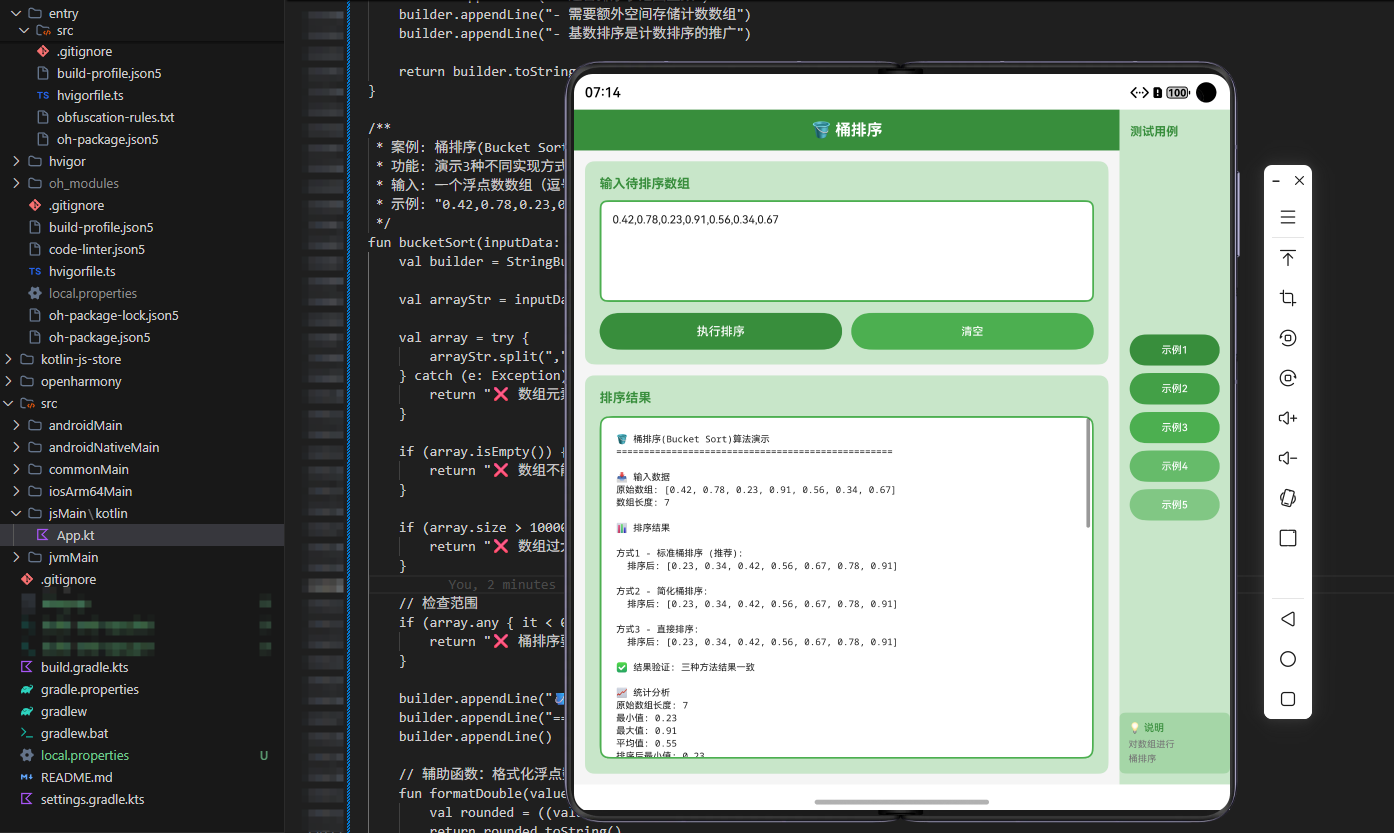
ArkTS版本为OpenHarmony鸿蒙平台提供了完整的用户界面。通过@State装饰器,我们可以管理应用的状态,当用户输入改变时,UI会自动更新。这个实现包含了输入浮点数数组的输入框,以及算法选择的下拉菜单。
在排序结果的显示中,我们显示了排序后的数组,并使用toFixed(2)来格式化浮点数显示。同时,我们还提供了所有方法的结果对比,这样用户可以验证不同方法的一致性。
性能演示功能允许用户在应用中直接看到不同算法的性能差异。通过对比排序100000个随机浮点数的时间,用户可以清楚地看到不同实现方式的性能表现。
应用场景分析
1. 数据库系统
在数据库系统中,桶排序用于快速排序浮点数和字符串。数据库优化器使用桶排序来处理大规模数据。
2. 数据分析
在数据分析中,桶排序用于数据分组和直方图生成。数据预处理使用桶排序来处理数据。
3. 图形处理
在图形处理中,桶排序用于颜色排序和像素分组。图像处理算法使用桶排序来处理像素数据。
4. 网络流量分析
在网络流量分析中,桶排序用于数据包分类。网络协议栈使用桶排序来排序数据包。
5. 机器学习
在机器学习中,桶排序用于特征分桶和数据离散化。数据预处理使用桶排序来处理特征数据。
性能优化建议
1. 选择合适的算法
对于均匀分布的数据,使用基础桶排序。对于数据分布不均匀,使用自适应桶排序。对于需要最优性能,使用加权桶排序。
2. 动态调整桶的数量
根据数据量和分布动态调整桶的数量,可以获得更好的性能。
3. 使用混合排序
对于小规模数据或数据范围小的情况,使用快速排序可能更高效。
4. 考虑并行化
桶排序易于并行化,可以在多核处理器上并行执行。
总结
桶排序是一种分布式排序算法,在处理浮点数排序和均匀分布的数据时性能优异。虽然算法思想相对简单,但其实现涉及多种不同的优化策略,从基础的桶排序到混合桶排序。
通过在KMP框架下实现这个算法,我们可以在多个平台上使用同一套代码,提高开发效率。混合桶排序是解决大多数排序问题的最优方案,可以根据数据特性自动选择最优算法。在OpenHarmony鸿蒙平台上,我们可以通过ArkTS调用Kotlin编译的JavaScript代码,或者直接在ArkTS中实现算法,实现真正的跨平台开发。
掌握这个经典算法的多种变体,不仅能够帮助开发者在面试中获得好成绩,更重要的是能够在实际项目中灵活应用这个算法,解决浮点数排序、数据分组等实际问题。
欢迎加入开源鸿蒙跨平台社区:https://openharmonycrossplatform.csdn.net

开源鸿蒙跨平台开发社区汇聚开发者与厂商,共建“一次开发,多端部署”的开源生态,致力于降低跨端开发门槛,推动万物智联创新。
更多推荐

 14
14 0
0- 0


 已为社区贡献18条内容

所有评论(0)