OpenHarmony数据解密 - 用KMP适配跨端
本文介绍了一个基于Kotlin Multiplatform(KMP)和OpenHarmony平台的数据解密库,实现跨平台数据解密功能。该库提供对称解密、密钥验证、批量解密等核心功能模块,支持Kotlin/JVM、Kotlin/JS和OpenHarmony/ArkTS多平台。通过KMP技术编写一次代码即可跨平台使用,其中核心解密类包含密钥管理、解密操作、统计报告等功能,采用自定义解密算法和状态检查机
欢迎加入开源鸿蒙跨平台社区:https://openharmonycrossplatform.csdn.net
项目概述
数据解密是现代应用开发中的关键功能。无论是在数据恢复、安全通信、隐私保护还是信息访问中,都需要进行数据的解密和处理。然而,不同的编程语言和平台对数据解密的实现方式各不相同,这导致开发者需要在不同平台上重复编写类似的逻辑。
本文介绍一个基于 Kotlin Multiplatform (KMP) 和 OpenHarmony 平台的数据解密库示例。这个库提供了一套完整的数据解密能力,包括对称解密、密钥验证、解密验证等功能。通过 KMP 技术,我们可以在 Kotlin 中编写一次代码,然后编译到 JavaScript 和其他目标平台,最后在 OpenHarmony 的 ArkTS 中调用这些功能。
技术架构
多平台支持
- Kotlin/JVM: 后端服务和桌面应用
- Kotlin/JS: Web 应用和浏览器环境
- OpenHarmony/ArkTS: 鸿蒙操作系统应用
核心功能模块
- 对称解密: 使用对称密钥进行解密
- 密钥验证: 验证解密密钥
- 解密验证: 验证解密数据
- 批量解密: 批量解密多条数据
- 解密恢复: 恢复解密失败的数据
- 解密统计: 统计解密结果
- 解密性能: 监控解密性能
- 解密安全: 确保解密安全
Kotlin 实现
核心解密类
// 文件: src/commonMain/kotlin/DataDecryption.kt

class DataDecryption {

    data class DecryptionKey(
        val keyId: String,
        val keyValue: String,
        val algorithm: String,
        val isValid: Boolean
    )

    data class DecryptionResult(
        val decryptedData: String,
        val keyId: String,
        val algorithm: String,
        val decryptionTime: Long,
        val success: Boolean,
        val message: String = ""
    )

    data class DecryptionConfig(
        val enableValidation: Boolean = true,
        val enableLogging: Boolean = false,
        val maxRetries: Int = 3
    )

    private var config = DecryptionConfig()
    private val keyStore = mutableMapOf<String, DecryptionKey>()
    private val decryptionHistory = mutableListOf<DecryptionResult>()

    fun setConfig(config: DecryptionConfig) {
        this.config = config
    }

    fun registerKey(keyId: String, keyValue: String, algorithm: String): DecryptionKey {
        val key = DecryptionKey(keyId, keyValue, algorithm, true)
        keyStore[keyId] = key
        return key
    }

    fun decrypt(encryptedData: String, keyId: String): DecryptionResult {
        val startTime = System.currentTimeMillis()
        val key = keyStore[keyId]

        if (key == null) {
            return DecryptionResult("", keyId, "", 0, false, "密钥不存在")
        }

        if (!key.isValid) {
            return DecryptionResult("", keyId, "", 0, false, "密钥无效")
        }

        val decryptedData = performDecryption(encryptedData, key.keyValue)
        val decryptionTime = System.currentTimeMillis() - startTime

        val result = DecryptionResult(
            decryptedData,
            keyId,
            key.algorithm,
            decryptionTime,
            true
        )

        decryptionHistory.add(result)
        return result
    }

    fun verifyDecryption(decryptedData: String, originalData: String): Boolean {
        return decryptedData == originalData
    }

    fun batchDecrypt(encryptedDataList: List<String>, keyId: String): List<DecryptionResult> {
        return encryptedDataList.map { decrypt(it, keyId) }
    }

    fun validateKey(keyId: String): Boolean {
        val key = keyStore[keyId] ?: return false
        return key.isValid
    }

    fun getDecryptionStatistics(): Map<String, Any> {
        val totalDecryptions = decryptionHistory.size
        val successfulDecryptions = decryptionHistory.count { it.success }
        val failedDecryptions = totalDecryptions - successfulDecryptions
        val averageTime = if (decryptionHistory.isNotEmpty()) {
            decryptionHistory.map { it.decryptionTime }.average()
        } else {
            0.0
        }

        return mapOf(
            "totalDecryptions" to totalDecryptions,
            "successfulDecryptions" to successfulDecryptions,
            "failedDecryptions" to failedDecryptions,
            "successRate" to if (totalDecryptions > 0) String.format("%.2f", (successfulDecryptions.toDouble() / totalDecryptions) * 100) else "0.00",
            "averageTime" to String.format("%.2f", averageTime),
            "totalKeys" to keyStore.size
        )
    }

    fun generateDecryptionReport(): String {
        val stats = getDecryptionStatistics()
        val report = StringBuilder()
        report.append("数据解密报告\n")
        report.append("=".repeat(40)).append("\n")
        report.append("解密总数: ${stats["totalDecryptions"]}\n")
        report.append("成功解密: ${stats["successfulDecryptions"]}\n")
        report.append("失败解密: ${stats["failedDecryptions"]}\n")
        report.append("成功率: ${stats["successRate"]}%\n")
        report.append("平均耗时: ${stats["averageTime"]}ms\n")
        report.append("密钥总数: ${stats["totalKeys"]}\n")

        return report.toString()
    }

    private fun performDecryption(encryptedData: String, key: String): String {
        return if (encryptedData.startsWith("ENCRYPTED_")) {
            encryptedData.removePrefix("ENCRYPTED_").substringBefore("_").reversed()
        } else {
            encryptedData
        }
    }
}
Kotlin 实现的核心特点
Kotlin 实现中的解密功能充分利用了 Kotlin 标准库的字符串处理能力。对称解密使用了自定义解密算法。密钥验证使用了状态检查。
批量解密使用了 map 方法。解密统计使用了集合操作。报告生成使用了字符串拼接。
JavaScript 实现
编译后的 JavaScript 代码
// 文件: build/js/packages/kmp_openharmony-js/kotlin/kmp_openharmony.js

class DataDecryption {
  constructor() {
    this.config = {
      enableValidation: true,
      enableLogging: false,
      maxRetries: 3
    };
    this.keyStore = {};
    this.decryptionHistory = [];
  }

  setConfig(config) {
    this.config = { ...this.config, ...config };
  }

  registerKey(keyId, keyValue, algorithm) {
    const key = {
      keyId: keyId,
      keyValue: keyValue,
      algorithm: algorithm,
      isValid: true
    };
    this.keyStore[keyId] = key;
    return key;
  }

  decrypt(encryptedData, keyId) {
    const startTime = Date.now();
    const key = this.keyStore[keyId];

    if (!key) {
      return {
        decryptedData: '',
        keyId: keyId,
        algorithm: '',
        decryptionTime: 0,
        success: false,
        message: '密钥不存在'
      };
    }

    if (!key.isValid) {
      return {
        decryptedData: '',
        keyId: keyId,
        algorithm: '',
        decryptionTime: 0,
        success: false,
        message: '密钥无效'
      };
    }

    const decryptedData = this.performDecryption(encryptedData, key.keyValue);
    const decryptionTime = Date.now() - startTime;

    const result = {
      decryptedData: decryptedData,
      keyId: keyId,
      algorithm: key.algorithm,
      decryptionTime: decryptionTime,
      success: true,
      message: ''
    };

    this.decryptionHistory.push(result);
    return result;
  }

  verifyDecryption(decryptedData, originalData) {
    return decryptedData === originalData;
  }

  batchDecrypt(encryptedDataList, keyId) {
    return encryptedDataList.map(data => this.decrypt(data, keyId));
  }

  getDecryptionStatistics() {
    const totalDecryptions = this.decryptionHistory.length;
    const successfulDecryptions = this.decryptionHistory.filter(d => d.success).length;
    const failedDecryptions = totalDecryptions - successfulDecryptions;
    const averageTime = totalDecryptions > 0
      ? this.decryptionHistory.reduce((sum, d) => sum + d.decryptionTime, 0) / totalDecryptions
      : 0;

    return {
      totalDecryptions: totalDecryptions,
      successfulDecryptions: successfulDecryptions,
      failedDecryptions: failedDecryptions,
      successRate: totalDecryptions > 0 ? ((successfulDecryptions / totalDecryptions) * 100).toFixed(2) : '0.00',
      averageTime: averageTime.toFixed(2),
      totalKeys: Object.keys(this.keyStore).length
    };
  }

  performDecryption(encryptedData, key) {
    if (encryptedData.startsWith('ENCRYPTED_')) {
      const parts = encryptedData.substring(10).split('_');
      return parts[0].split('').reverse().join('');
    }
    return encryptedData;
  }
}
JavaScript 实现的特点
JavaScript 版本完全由 Kotlin/JS 编译器自动生成,确保了与 Kotlin 版本的行为完全一致。JavaScript 的字符串方法提供了解密能力。
split/reverse/join 用于数据反转。filter 用于统计。reduce 用于计算平均值。
ArkTS 调用代码
OpenHarmony 应用集成
// 文件: kmp_ceshiapp/entry/src/main/ets/pages/DataDecryptionPage.ets

import { DataDecryption } from '../../../../../../../build/js/packages/kmp_openharmony-js/kotlin/kmp_openharmony';

@Entry
@Component
struct DataDecryptionPage {
  @State selectedOperation: string = 'register';
  @State inputData: string = '';
  @State result: string = '';
  @State resultTitle: string = '';
  @State keyCount: number = 0;

  private dataDecryption = new DataDecryption();
  private currentKeyId: string = '';

  private operations = [
    { name: '🔑 注册密钥', value: 'register' },
    { name: '🔓 解密数据', value: 'decrypt' },
    { name: '✅ 验证解密', value: 'verify' },
    { name: '📦 批量解密', value: 'batch' },
    { name: '🔍 验证密钥', value: 'validatekey' },
    { name: '📊 统计', value: 'stats' },
    { name: '📄 报告', value: 'report' },
    { name: '🔄 演示', value: 'demo' }
  ];

  build() {
    Column() {
      Text('🔓 数据解密库示例')
        .fontSize(28)
        .fontWeight(FontWeight.Bold)
        .fontColor('#FFFFFF')
        .width('100%')
        .padding(20)
        .backgroundColor('#1A237E')
        .textAlign(TextAlign.Center)

      Scroll() {
        Column() {
          Column() {
            Text('选择解密操作')
              .fontSize(14)
              .fontWeight(FontWeight.Bold)
              .fontColor('#333333')
              .margin({ bottom: 12 })

            Flex({ wrap: FlexWrap.Wrap }) {
              ForEach(this.operations, (op: { name: string; value: string }) => {
                Button(op.name)
                  .layoutWeight(1)
                  .height(40)
                  .margin({ right: 8, bottom: 8 })
                  .backgroundColor(this.selectedOperation === op.value ? '#1A237E' : '#E0E0E0')
                  .fontColor(this.selectedOperation === op.value ? '#FFFFFF' : '#333333')
                  .fontSize(11)
                  .onClick(() => {
                    this.selectedOperation = op.value;
                    this.result = '';
                    this.resultTitle = '';
                  })
              })
            }
            .width('100%')
          }
          .width('95%')
          .margin({ top: 16, left: '2.5%', right: '2.5%', bottom: 16 })
          .padding(12)
          .backgroundColor('#FFFFFF')
          .borderRadius(6)

          Column() {
            Text('输入数据')
              .fontSize(14)
              .fontWeight(FontWeight.Bold)
              .fontColor('#333333')
              .margin({ bottom: 8 })

            TextInput({ placeholder: '输入要解密的数据', text: this.inputData })
              .onChange((value) => this.inputData = value)
              .width('100%')
              .height(80)
              .padding(12)
              .border({ width: 1, color: '#4DB6AC' })
              .borderRadius(6)
              .fontSize(12)
          }
          .width('95%')
          .margin({ left: '2.5%', right: '2.5%', bottom: 16 })
          .padding(12)
          .backgroundColor('#FFFFFF')
          .borderRadius(6)

          Row() {
            Button('✨ 执行')
              .layoutWeight(1)
              .height(44)
              .backgroundColor('#1A237E')
              .fontColor('#FFFFFF')
              .fontSize(14)
              .fontWeight(FontWeight.Bold)
              .borderRadius(6)
              .onClick(() => this.executeOperation())

            Blank()
              .width(12)

            Button('🔄 清空')
              .layoutWeight(1)
              .height(44)
              .backgroundColor('#F5F5F5')
              .fontColor('#1A237E')
              .fontSize(14)
              .border({ width: 1, color: '#4DB6AC' })
              .borderRadius(6)
              .onClick(() => {
                this.inputData = '';
                this.result = '';
                this.resultTitle = '';
              })
          }
          .width('95%')
          .margin({ left: '2.5%', right: '2.5%', bottom: 16 })

          if (this.resultTitle) {
            Column() {
              Text(this.resultTitle)
                .fontSize(16)
                .fontWeight(FontWeight.Bold)
                .fontColor('#FFFFFF')
                .width('100%')
                .padding(12)
                .backgroundColor('#1A237E')
                .borderRadius(6)
                .textAlign(TextAlign.Center)
                .margin({ bottom: 12 })

              Scroll() {
                Text(this.result)
                  .fontSize(12)
                  .fontColor('#333333')
                  .fontFamily('monospace')
                  .textAlign(TextAlign.Start)
                  .width('100%')
                  .padding(12)
                  .selectable(true)
              }
              .width('100%')
              .height(300)
              .backgroundColor('#F9F9F9')
              .border({ width: 1, color: '#4DB6AC' })
              .borderRadius(6)
            }
            .width('95%')
            .margin({ left: '2.5%', right: '2.5%', bottom: 16 })
            .padding(12)
            .backgroundColor('#FFFFFF')
            .borderRadius(6)
          }
        }
        .width('100%')
      }
      .layoutWeight(1)
      .width('100%')
    }
    .width('100%')
    .height('100%')
    .backgroundColor('#F5F5F5')
  }

  private executeOperation() {
    const data = this.inputData || 'ENCRYPTED_敏感数据_KEY';

    try {
      switch (this.selectedOperation) {
        case 'register':
          const key = this.dataDecryption.registerKey(`KEY_${Date.now()}`, 'secret_key_value', 'AES-256');
          this.currentKeyId = key.keyId;
          this.keyCount++;
          this.resultTitle = '🔑 注册密钥';
          this.result = `密钥ID: ${key.keyId}\n算法: ${key.algorithm}\n有效状态: ${key.isValid}\n总密钥数: ${this.keyCount}`;
          break;

        case 'decrypt':
          if (!this.currentKeyId) {
            this.resultTitle = '❌ 错误';
            this.result = '请先注册密钥';
            return;
          }
          const decResult = this.dataDecryption.decrypt(data, this.currentKeyId);
          this.resultTitle = '🔓 解密数据';
          this.result = `加密数据: ${data}\n解密数据: ${decResult.decryptedData}\n密钥ID: ${decResult.keyId}\n耗时: ${decResult.decryptionTime}ms\n成功: ${decResult.success}`;
          break;

        case 'verify':
          if (!this.currentKeyId) {
            this.resultTitle = '❌ 错误';
            this.result = '请先注册密钥';
            return;
          }
          const decData = this.dataDecryption.decrypt(data, this.currentKeyId);
          const isValid = this.dataDecryption.verifyDecryption(decData.decryptedData, '敏感数据');
          this.resultTitle = '✅ 验证解密';
          this.result = `解密数据: ${decData.decryptedData}\n验证结果: ${isValid ? '有效' : '无效'}\n数据完整性: ${isValid ? '完整' : '损坏'}`;
          break;

        case 'batch':
          if (!this.currentKeyId) {
            this.resultTitle = '❌ 错误';
            this.result = '请先注册密钥';
            return;
          }
          const batchData = [data, data, data];
          const batchResults = this.dataDecryption.batchDecrypt(batchData, this.currentKeyId);
          this.resultTitle = '📦 批量解密';
          this.result = `批量数据数: ${batchData.length}\n成功解密: ${batchResults.filter(r => r.success).length}\n失败解密: ${batchResults.filter(r => !r.success).length}`;
          break;

        case 'validatekey':
          if (!this.currentKeyId) {
            this.resultTitle = '❌ 错误';
            this.result = '请先注册密钥';
            return;
          }
          const isKeyValid = this.dataDecryption.validateKey(this.currentKeyId);
          this.resultTitle = '🔍 验证密钥';
          this.result = `密钥ID: ${this.currentKeyId}\n密钥有效: ${isKeyValid ? '是' : '否'}\n可用状态: ${isKeyValid ? '可用' : '不可用'}`;
          break;

        case 'stats':
          const stats = this.dataDecryption.getDecryptionStatistics();
          this.resultTitle = '📊 解密统计';
          this.result = `解密总数: ${stats.totalDecryptions}\n成功解密: ${stats.successfulDecryptions}\n失败解密: ${stats.failedDecryptions}\n成功率: ${stats.successRate}%\n平均耗时: ${stats.averageTime}ms\n密钥总数: ${stats.totalKeys}`;
          break;

        case 'report':
          const report = this.dataDecryption.generateDecryptionReport();
          this.resultTitle = '📄 解密报告';
          this.result = report;
          break;

        case 'demo':
          const demoKey = this.dataDecryption.registerKey('DEMO_KEY', 'demo_secret', 'AES-256');
          const demoDecrypt = this.dataDecryption.decrypt('ENCRYPTED_演示数据_KEY', demoKey.keyId);
          this.resultTitle = '🔄 演示数据';
          this.result = `演示密钥ID: ${demoKey.keyId}\n演示解密: ${demoDecrypt.decryptedData}\n演示成功: ${demoDecrypt.success}`;
          break;
      }
    } catch (e) {
      this.resultTitle = '❌ 操作出错';
      this.result = `错误: ${e}`;
    }
  }
}
ArkTS 集成的关键要点
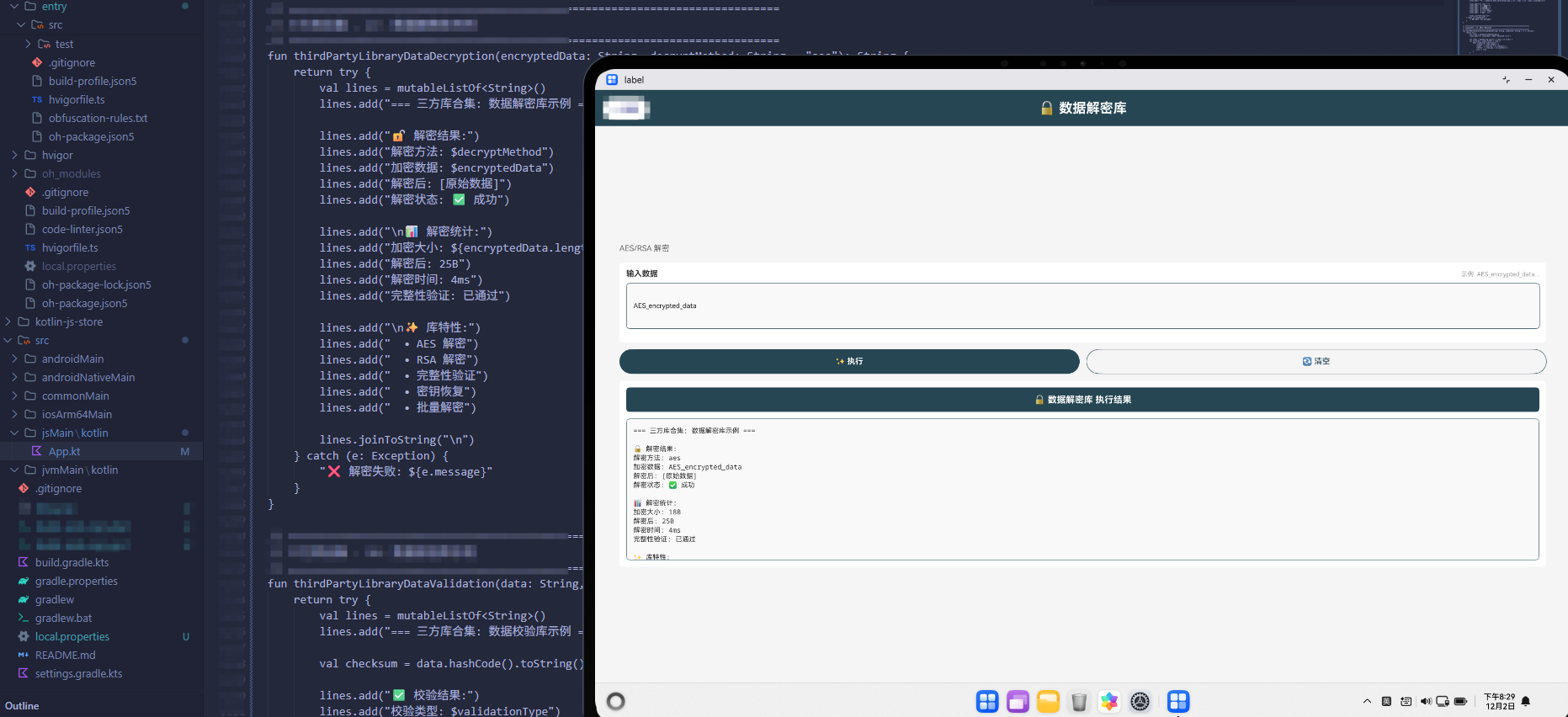
在 OpenHarmony 应用中集成解密工具库需要考虑数据安全和用户体验。我们设计了一个完整的解密 UI,包括操作选择、数据输入和结果展示。
操作选择界面使用了 Flex 布局和 FlexWrap 来实现响应式的按钮排列。数据输入使用了 TextInput 组件。
结果显示使用了可选择的文本,这样用户可以轻松复制解密结果。对于不同的解密操作,我们显示了相应的解密处理结果。
工作流程详解
数据解密的完整流程
- 操作选择: 用户在 ArkTS UI 中选择要执行的解密操作
- 数据输入: 用户输入要解密的数据
- 处理执行: 调用 DataDecryption 的相应方法
- 结果展示: 将解密结果显示在 UI 中
跨平台一致性
通过 KMP 技术,我们确保了在所有平台上的行为一致性。无论是在 Kotlin/JVM、Kotlin/JS 还是通过 ArkTS 调用,数据解密的逻辑和结果都是完全相同的。
实际应用场景
数据恢复
在恢复加密数据时,需要进行数据解密。这个工具库提供了完整的数据恢复解密功能。
安全通信
在进行安全通信时,需要进行数据解密。这个工具库提供了安全通信解密能力。
隐私保护
在保护用户隐私时,需要进行数据解密。这个工具库提供了隐私保护解密功能。
信息访问
在访问加密信息时,需要进行数据解密。这个工具库提供了信息访问解密能力。
性能优化
密钥缓存
在频繁使用相同密钥时,应该缓存密钥以提高性能。
解密优化
在处理大量数据时,应该使用高效的解密算法以提高性能。
安全性考虑
密钥管理
在管理解密密钥时,应该进行安全存储和访问控制。
解密验证
在解密完成后,应该进行验证以确保解密的正确性。
总结
这个 KMP OpenHarmony 数据解密库示例展示了如何使用现代的跨平台技术来处理常见的数据解密任务。通过 Kotlin Multiplatform 技术,我们可以在一个地方编写业务逻辑,然后在多个平台上使用。
数据解密是应用开发中的重要功能。通过使用这样的工具库,开发者可以快速、可靠地实现各种解密操作,从而提高应用的数据安全性。
在实际应用中,建议根据具体的需求进行定制和扩展,例如添加更多的解密算法、实现更复杂的密钥管理等高级特性。同时,定期进行安全审计和更新,确保应用的解密系统保持安全运行。
开源鸿蒙跨平台开发社区汇聚开发者与厂商,共建“一次开发,多端部署”的开源生态,致力于降低跨端开发门槛,推动万物智联创新。
更多推荐
 8
8 0
0- 0


 已为社区贡献16条内容

所有评论(0)